Synthetic users and experimentation in 2027

Experimentation needs real users to tell what actually works.
But synthetic users could give experimentation teams another way to explore how real users might respond to an experience before they commit actual traffic to it. However, their role, and what they can tell us, is still being worked out.
We do know that synthetic users cannot replace real users. But how will they help use real users better?
What are synthetic users?
A synthetic audience is a “modeled representation” of an audience: an AI-generated population designed to approximate how a particular group of people might respond to questions, concepts, content, or experiences.
This representation is built using first-party customer data, surveys, interviews, behavioral data, demographic information, customer reviews, or other audience information. Synthetic audience solution providers use different combinations of data and modeling techniques, so synthetic audiences don't describe a single standardized methodology.
In experimentation, synthetic users are best understood as a learning layer around experimentation: a way to model how different audience segments might respond to an idea, experience or variant before, or alongside, the real-world experiment.
To see where this could go in experimentation, it helps to look at where synthetic audiences are already being used commercially: media and advertising.
What synthetic users are already doing
Media is one of the first places where synthetic audiences are moving from an emerging concept into real-world commercial use. Publishers and advertisers are beginning to model audiences from first-party and other data to test messaging, creative and audience strategies.
Times ExplorAItion: pressure-testing ideas before going live
In April 2026, News UK launched Times ExplorAItion, a synthetic-audience product built with Electric Twin. In its own words, Electric Twin “builds a simulated audience from your customer data so every answer reflects what your actual customers would say.”
Essentially, News UK feeds its first-party data along with huge volumes of third-party data into Electric Twin. Electric Twin’s modeling platform then uses these inputs to create synthetic versions of key Times audience segments. Teams can query these audiences much like a research panel: testing messaging, running surveys and exploring creative ideas. Advertisers can pressure-test propositions and campaign concepts before committing to a live campaign.
But the more interesting part is that synthetic users are being used for more than advertising. In one instance, News UK used synthetic users for naming a new business podcast. The team tested four potential names with its synthetic audience, and “The Business” emerged as the winner. It performed well with the broader reader panel, but particularly strongly with the specific demographic the podcast was intended to reach.
What experimentation could borrow? A fast way to narrow a set of candidates before any live test.
Svenska Dagbladet: keeping an audience perspective in the decision loop
The Reuters Institute's 2026 industry report describes the Swedish publisher experimenting with an AI-generated research group based on interviews with existing and potential subscribers. The resulting “digital twins” are intended to give editors an always-available audience perspective on questions such as story treatment and headlines. The application is editorial rather than experimental, but it shows a principle that could be relevant to experimentation: having a modelled audience available as decisions are made, rather than only at formal research stages.
WPP Media and Givsly: from simulated audiences to real media buying
In June 2026, Digiday reported that WPP Media partnered with Givsly to test synthetic audiences in programmatic media buying. Givsly's system uses a Claude-based model to combine its audience data with WPP Media's first- and second-party data to build synthetic audience profiles, which were then used in programmatic campaigns for four beauty and fashion brands across CTV and online video. Early tests reportedly produced a 2% lift in video completion rates. While this is an early industry result rather than independent validation, it shows how synthetic audiences are beginning to move from audience research into actual media decisions.
The idea that a synthetic layer can sit inside a live, revenue-generating workflow rather than only in research is here.
That opens up a more interesting question for experimentation: could synthetic users similarly help teams make decisions around what to build, what to test and where to commit real traffic?
Synthetic users in experimentation
The potential role of synthetic users becomes clearer when we look at where they could fit across the three stages of the experimentation lifecycle: before, during and after the live experiment.
1. Pre-experiment: decide what deserves real traffic
This is currently the clearest role. Before committing real traffic to a hypothesis, teams can expose synthetic users to:
- concepts and prototypes
- messaging/copy
- pricing options
- landing pages & staging websites
- checkout flows
- onboarding experiences
- changes to elements like CTAs, layouts, etc.
Commercial vendors already frame it this way. Personia, for example, explicitly describes synthetic personas as a pre-screening layer: teams can run many variants through a synthetic panel, narrow the set, and then test the survivors with real traffic. The company explicitly says the synthetic stage does not replace the live A/B test or its statistical significance.
neuroflash similarly positions its synthetic audience product as pre-testing: creative, headlines, positioning and landing-page concepts can be evaluated against an audience model before live media or experimentation spend.
The terminology differs (pre-screening, pre-testing, synthetic research) but the underlying idea is similar: filter before you spend.
2. During the experiment: a second evidence layer
Synthetic users don't necessarily disappear once the live test starts.
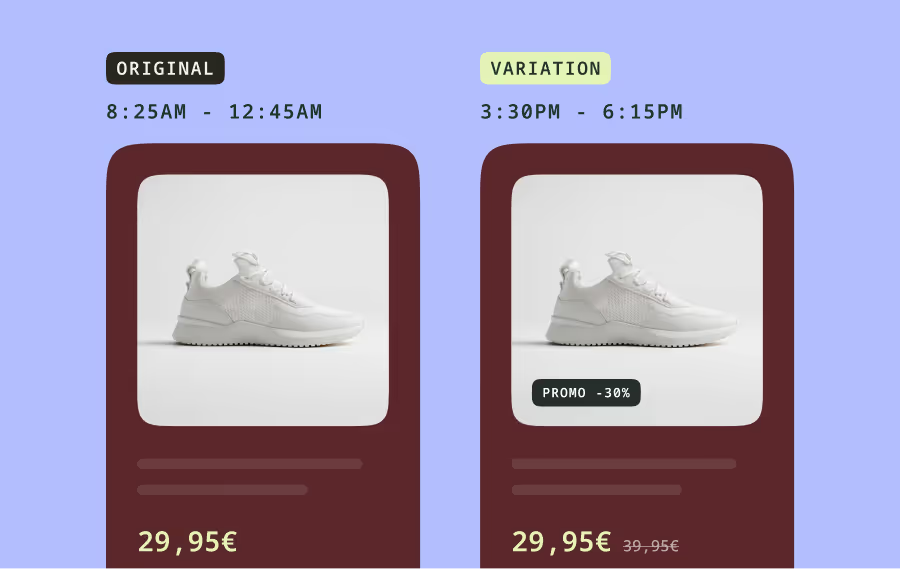
Imagine: Control A versus treatment B
A synthetic audience can potentially be exposed to representations of both variants through screenshots, prototypes, staging URLs or browser-accessible experiences.
Commercial platforms such as Synthetic Users already let AI personas interact with staging websites, complete assigned tasks and surface points of confusion or friction in the journey.
So conceptually, you can have:
The synthetic audience isn't replacing the live experiment’s real traffic. Instead, it can provide an additional audience perspective while the experiment is running: helping teams explore how different segments might respond, surface potential friction and identify questions worth investigating against the real-world results. In-flight synthetic testing also doubles up as real-time diagnostic QA, surfacing unexpected friction, identifying breaking edge cases, or generating secondary hypotheses before the live data comes in, rather than trying to influence the live test's statistical trajectory.
Its role here is not to provide another source of statistical evidence for the A/B test, but to add another layer of learning around it.
3. Post-experiment: turn results into the next hypotheses
The post-experiment role is the most speculative, and the most interesting when the synthetic audience's behavior lines up with what the real experiment showed.
Suppose a live A/B test shows variant B increased conversion, and the synthetic audience also responds more positively to B than to the control. That doesn't establish that the model has captured why B worked, or that it will predict the next experiment correctly. But it has at least reproduced the direction of an observed real-world effect. From there, the synthetic audience can be used to explore adjacent possibilities before committing more real traffic.
The real experiment remains the source of validation. The synthetic audience explores the space around a demonstrated result; it doesn't retrospectively prove why it happened. There is another reason for caution: once a model is told the outcome, it can generate remarkably plausible explanations for it. Plausibility is not evidence.
Where synthetic users help experimentation, and where they break down
The same capabilities that make synthetic users useful to experimentation also create their biggest risks.
How do you know whether to trust synthetic users in experimentation?
As of now, much of the evidence comes from vendors and early pilots, and none of the examples above establishes that a synthetic winner was also the real-world winner.
So before adding synthetic users to an experimentation roadmap, start with a blind backtest on your last 10 live A/B tests (including winning, losing, and flat variants).
Compare the synthetic panel's choices against what actually happened in the real world: how often did it select the eventual winner? Did it get the direction of the effect right? And how close was its estimate of effect size? If a synthetic panel can't directionally pick your past winners, it shouldn't filter your future variants.
You could also test for homogeneity. If different synthetic segments repeatedly produce almost identical responses, the panel may not be capturing meaningful differences between audiences.
Tracking performance over time would also matter. Both the underlying audience and the models used to represent it can change, so a synthetic panel that performs well today should not be assumed to remain reliable indefinitely.
Will you use synthetic users for your experimentation?
While synthetic users are not a way to manufacture statistical power, sophisticated synthetic audiences and digital-twin approaches could have a place across the experimentation lifecycle.
Their emerging use cases go beyond simulating research. Synthetic audiences could potentially sit in parallel with the experimentation process: helping teams screen ideas before real traffic is committed, explore possible responses alongside live experiments, and identify what may be worth testing next.
However, the opportunity isn't to replace real users, but to make every real-user experiment more deliberate, more informed and more valuable.