Samsung gains autonomy and speed in its most advanced tests with PBX
Industry
E-commerce & Retail
key features
Prompt-Based Experimentation

+140K
monthly visitors
75%
of traffic is from mobile
up to 98%
time saved thanks to PBX
At a glance:
With PBX (Prompt-Based Experimentation), Samsung accelerates their experimentation and gains greater autonomy.
Key takeaways:
- Tests are designed in 30 to 40 minutes using PBX, compared to 3 to 4 days previously.
- An average of 15 tests launched per month, versus 5 before PBX, showing a significantly increased experimentation capacity.
- More autonomy for the CRO team, enabling them to build a more ambitious roadmap and achieve better ROI.
A mature but limited CRO digital environment
Samsung B2B has a strong CRO organization with a dual CRO and Analytics focus: a prioritized roadmap, a shared backlog, regular analysis, and a strong testing discipline. Yet despite this structure, one persistent limitation remained: whenever an idea required code, the team had to rely on developers. This dependency extended timelines, complicated back and forth iterations, and naturally limited the scope of the hypotheses being tested. Some promising ideas were set aside because they were considered too time consuming, too costly, or simply unfeasible without technical intervention. The arrival of PBX completely changed this. The CRO team can now design, adjust, and deploy sophisticated technical variations fully autonomously, without technical dependency. As a result, developers can focus on higher value tasks.
{{quote-1}}
{{use-case-1}}
Control the appearance and disappearance of the navigation menu with a single prompt
One of the first tests launched with PBX focused on the navigation bar, a key element of the user journey. On mobile, which accounts for up to 80% of traffic, and on desktop, the menu disappears on scroll. A standard behavior, but Samsung wanted to assess the impact of bringing the menu back on scroll-up to make it easier for users to enter the purchase funnel. Before PBX, creating this type of interaction would have required custom JavaScript, complex front-end integration, and multiple dev + QA cycles to ensure a smooth experience across all channels. With PBX with just a few lines of prompt, the variation is generated automatically. The menu reappears perfectly on scroll-up, the behavior is fully responsive, and the test was launched in under 15 minutes. While the initial results already show an increase in funnel entry, the real impact is elsewhere: Samsung can now test advanced UX behaviors that would never have been prioritized from a development standpoint. PBX removes the barrier between UX intention and technical feasibility.
{{quote-2}}
{{metric-block-1}}
{{use-case-2}}
Dynamic content injection implemented without technical assistance
Another example is the dynamic enrichment of the ‘buying’ section on product pages. The teams wanted to consolidate essential technical information, which had previously been scattered across a long marketing page. The goal was to bring this data closer to the moment when the user makes their purchase decision. Normally, this type of test involves numerous steps: navigating to another page, extracting the right elements, reformatting them to fit perfectly within the design, adding a navigation anchor… and finally managing anti-flicker measures and tracking. In short, several days of work. With PBX, it was all done through a series of prompts. The tool automatically retrieved the headings (H2) and paragraphs, restructured them into a table, and re-injected them exactly where needed, with a fully functional anchor.In 30 minutes, Samsung had an advanced, elegant variation, immediately testable, without a single line of code. A clear demonstration of PBX’s ability to turn a complex idea into an operational test almost instantly.
{{metric-block-2}}
{{use-case-3}}
A new field of experimentation
PBX doesn’t just speed up test creation: it transforms the way the CRO team approaches experimentation. Now:
- Technical ideas are no longer blocked by a lack of technical resources.
- Prototypes are built directly in PBX, streamlining internal approvals.
- Prompts make it possible to explore multiple approaches in just a few minutes.
- The tool is used as much for ideation as for building fully realized variations.
The result: a roadmap that was once limited by integration capacity has become a space guided by creativity, impact, and data. This new autonomy has significantly increased the monthly test volume, from an average of 5 to 15 tests (+200%), with no change in team size.
{{divider}}
Conclusion
With PBX, Samsung B2B has reached a turning point. The team no longer just maintains a steady pace of optimization they can now launch tests that were previously impossible on their own. Dynamic variations, advanced behaviors, complex technical manipulations… everything can be executed in just minutes.This newfound autonomy dramatically accelerates and elevates the CRO approach. Ideas no longer linger in the backlog; they come to life almost immediately. Experimentation becomes bolder, more continuous, and more strategic, leading to even higher ROI for the teams.
Learn more
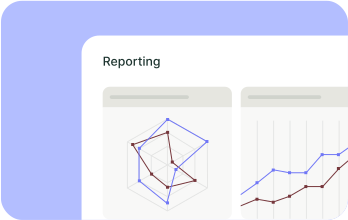
Enhance all-team experimentation with Kameleoon’s new results page
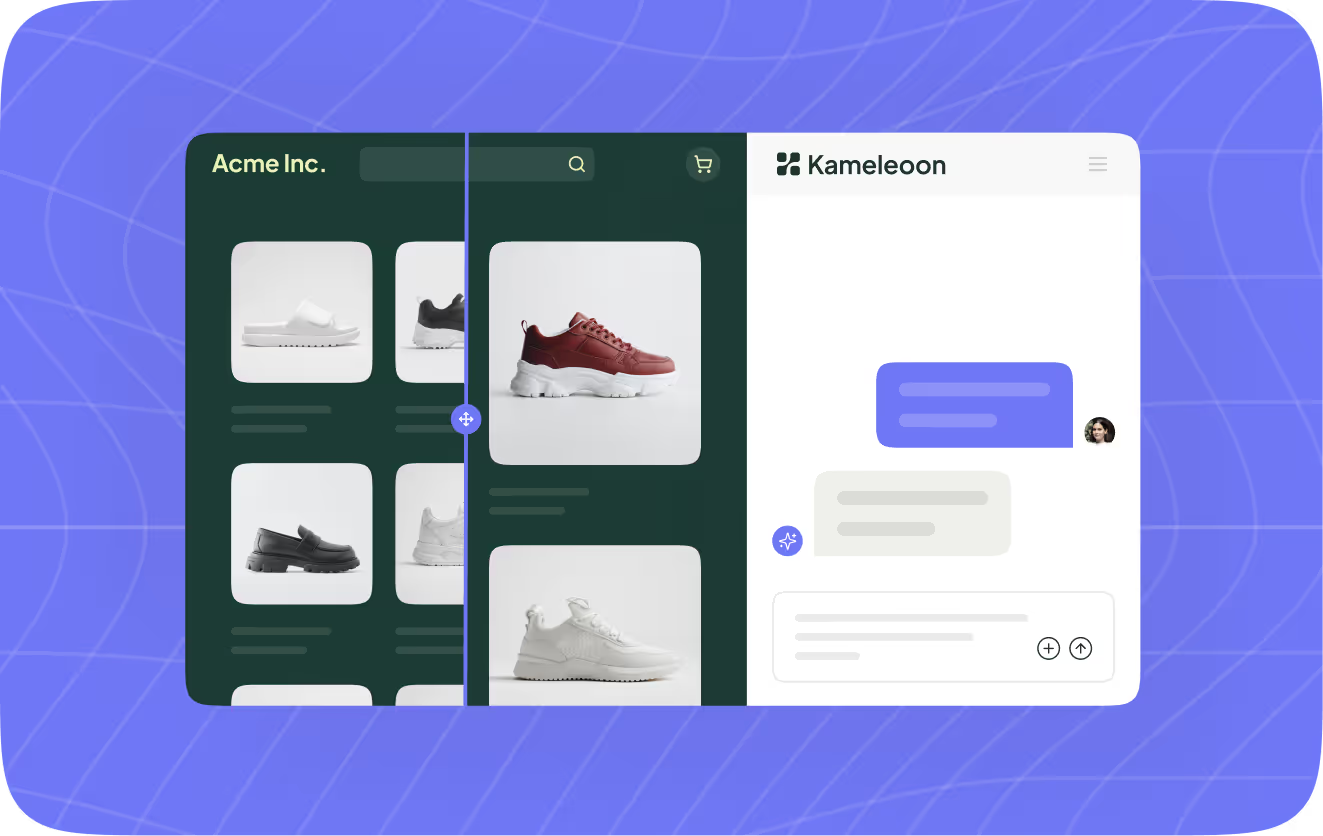
Prompt-Based Experimentation
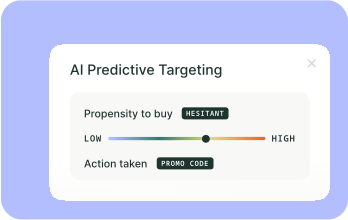
AI Predictive Targeting
PBX doesn’t just save time, it expands what’s possible. For Samsung B2B, it becomes the engine of continuous innovation, powering a high-performing growth strategy.

We are faster because we rely less on developers, and when we do need them, we can provide them with high-quality prototypes generated with PBX to align even more quickly on the expected outcome.
.avif)
This test would have taken 3–4 days of development. We did it in 30 minutes.

15 mins
preparation without technical intervention
1
prompt
1
responsive variant
30 mins
of preparation vs 3 to 4 days without PBX
0
technical resources required
+230%
in average cart value
Power experiments with user insights
Connect Mixpanel to Kameleoon for real-time insights and cohort-based experimentation.