What is real-time targeting?


Most websites treat all visitors the same, showing the same homepage, banners, and offers, regardless of their browsing history or current interests.
Real-time targeting closes this gap by adapting the content instantly based on visitors' live session behavior. It provides relevant experiences without the delay of data refreshes.
This article will explain what real-time targeting is, how it works, and how artificial intelligence tools like AI Predictive Targeting makes it scalable.
Real-time targeting: what it is and how it works
Real-time targeting is a marketing strategy that delivers personalized messages and custom on-site experiences to users at the exact moment of their greatest relevance. It analyzes live behavioral signals, such as what a user is browsing, clicking, or buying, to instantly adjust the content or ads they see.
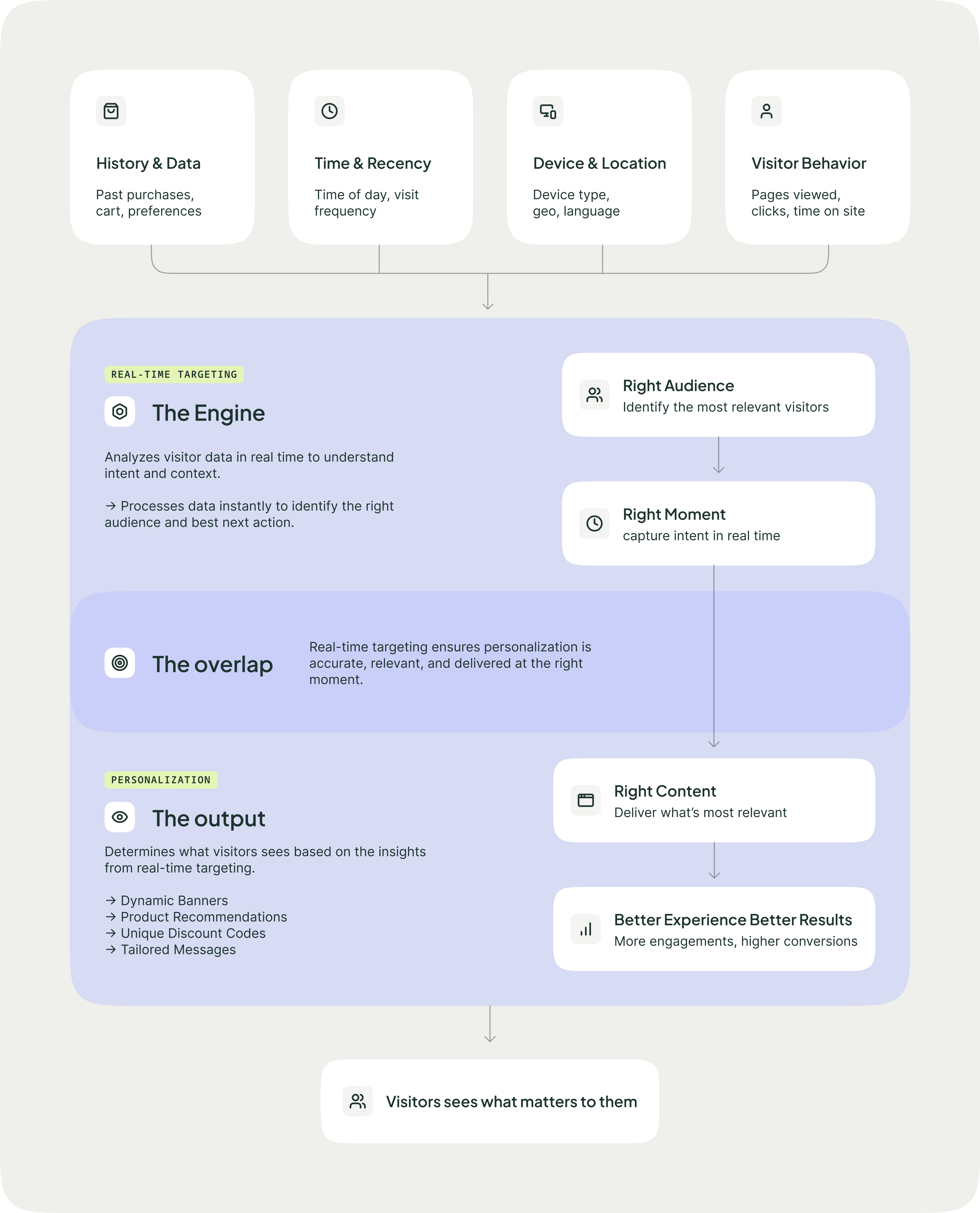
There is an overlap between real-time targeting and real-time personalization, but a difference exists.
Real-time targeting is the engine that drives the process, while personalization is the final visual output. Website personalization dictates what the visitor sees, such as specific banners, dynamic product recommendations, or unique discount codes.
Real-time targeting ensures personalization remains accurate and timely by showing relevant content to the right audience at the right moment, aligning with the visitor's intent.
A comparison of real-time vs. static targeting
Most targeting systems run on a fixed schedule, where audience segments refresh daily or weekly. This keeps converted users in the acquisition pool and makes it more expensive to reacquire customers who have already made a purchase.
Real-time targeting solves this issue by updating segments instantly as the visitor acts. It captures a visitor's high purchase intent in the moment, offering more value than segments based on historical or outdated behavior.
For example, in e-commerce, if a visitor adds a digital camera to their shopping cart but pauses before checkout, real-time targeting captures this intent instantly. Rather than waiting for a delayed segment refresh to send a cart abandonment email the next day, the system immediately triggers a recommendation for compatible memory cards. This approach turns a single item into a higher-value order directly on the checkout screen.
Here is the difference table of real-time vs. static targeting:
Types of signals real-time targeting reads
A real-time targeting system processes data in milliseconds and categorizes incoming information into distinct, readable signals. These signals give the system the context to trigger the right marketing action. A strong platform reads five main signal types:
- Behavioral signals track the user's interactions with the digital property. The tracking engine monitors page views, scrolling activity, precise mouse clicks, and the exact time spent evaluating specific content blocks.
- Contextual signals add environmental constraints to the user profile by capturing the operating system, device type, geographic location, and the channel that brought the visitor to the site.
- Transactional signals monitor financial intent. They track current shopping cart contents, active cart values, and historical purchase data. For instance, banking institutions use these signals securely. If a customer with a basic checking account repeatedly visits a mortgage rate calculator, they are generating a transactional intent signal. When they next log in, the app instantly reprioritizes to feature mortgage content or advisor contacts.
- Declared signals use explicit user-provided data from form submissions, loyalty program databases, or external data management platforms.
- Predictive signals use AI to calculate a real-time propensity score. They trigger automated actions when behavioral patterns indicate a high likelihood of conversion.
How real-time targeting works
Real-time targeting runs through a continuous sequence of steps. Each one connects directly to the next.
Data collection
The process starts with instant client-side data collection. Modern experimentation platforms use local storage within the user's browser to store behavioral targeting data.
Local storage allows the tracking script to store contextual and behavioral data on the device without affecting page load speeds or exceeding storage limits.
The JavaScript tracking engine captures visited URLs, device types, screen sizes, and click events instantly, writing this information into secure local storage keys.
This local data architecture gives the targeting system access to visitor history with minimal latency and zero impact on the visual user experience.
Identity resolution
As data flows into the system, the platform determines exactly who the visitor is. Identity resolution connects anonymous browsing activity with known user profiles across multiple devices and touchpoints. The system reads browser cookies, deterministic device IDs, and session codes to identify returning users.
When a visitor browses on a mobile device and later returns on a desktop, the backend server synchronizes the unique visitor code across both environments using specialized software development kits (SDKs).
The system stitches the browsing histories into a single analytical profile, preventing redundant offers to visitors who have already converted on a separate device.
Segment and trigger evaluation
Once the platform collects the data and resolves the user identity, the optimization engine evaluates the user against predefined segments and active triggers.
The segment defines who the visitor is based on stable attributes, demographic traits, and past behavioral interactions.
The trigger defines the exact real-time condition that must occur to activate the personalized experience.
The system continuously evaluates both conditions in parallel. When the visitor matches the segment parameters and trips the trigger rules, the platform authorizes the targeting action. Separating segments from triggers lets marketing teams adjust trigger logic without changing the core audience segmentation definition.
This is highly effective for travel and tourism brands aligning digital experiences with offline campaigns. If a user searches a paid term tied to a live TV commercial, that behavioral entry acts as the trigger.
Because they match the segment, the booking page instantly reconfigures its background imagery to match the commercial's destination. This strategy, used by the Travista travel agency, helped bring conversion rates up to 48%.
Decision and delivery
After a positive eligibility match, the engine decides which specific digital experience to deliver to the user. The delivery infrastructure pushes the personalized content to the user's screen in milliseconds.
Some platforms load the original page before the personalized variant appears, creating a visible flash known as flickering. It destroys the user experience, creates visual confusion, and invalidates test data because users realize they are part of an experiment.
Advanced platforms like Kameleoon use anti-flicker technology and asynchronous CDN delivery to deliver personalized experiences instantly and preserve visual stability and visitor trust.
Learning and optimization
The targeting process monitors how the user interacts with the targeted experience. It tracks conversions, engagement metrics, click-through rates, and bounce rates. The targeting system feeds this performance data back into the central data pipeline.
The AI model updates its internal logic based on outcomes, determining which variants perform best for specific audience segmentation. It adapts its future recommendations and shifts traffic toward winning variants and away from underperformers.
{{blue-block-1}}
How to get started with real-time targeting
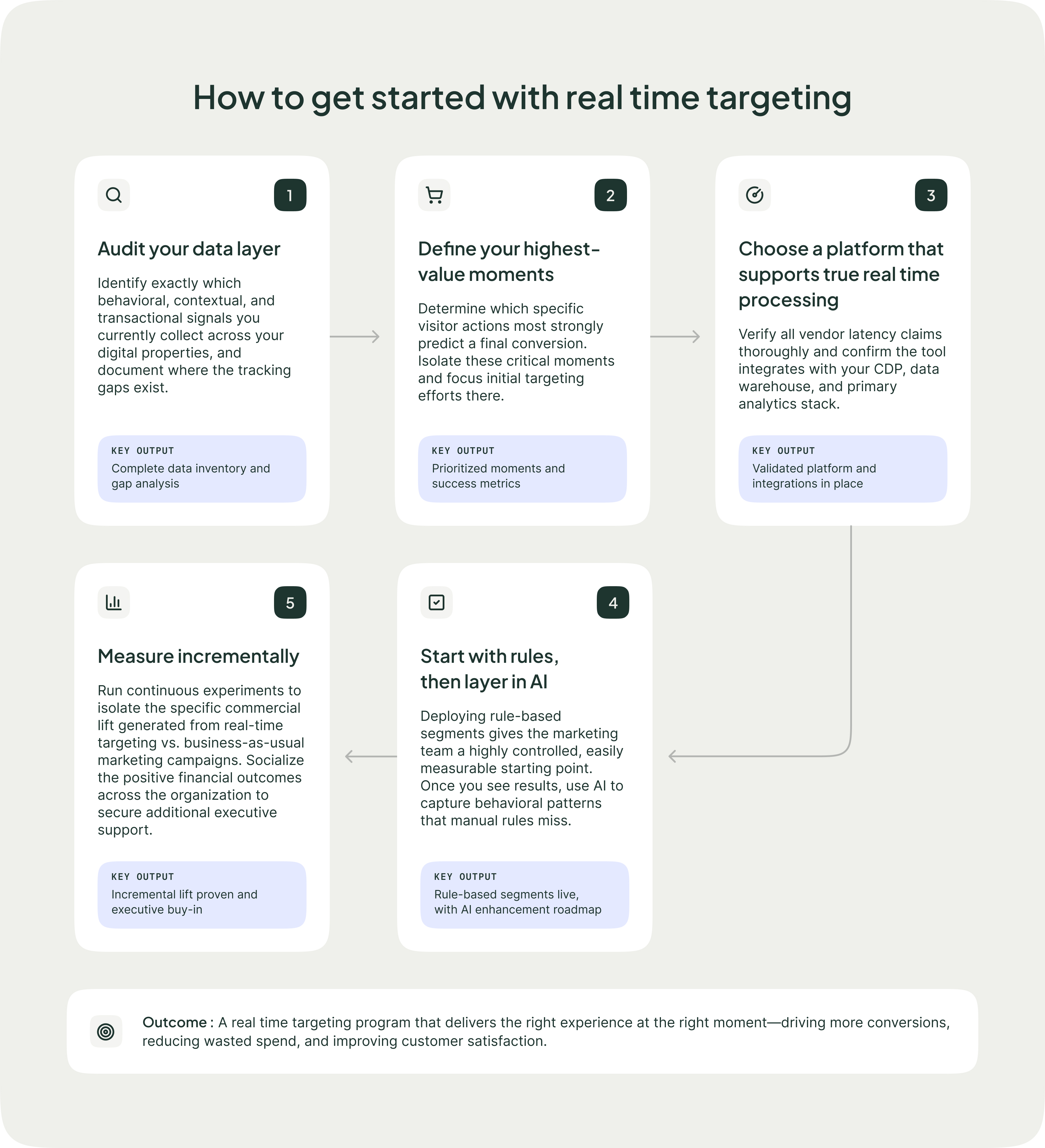
Moving from a traditional batch-processing system to a real-time targeting strategy requires a step-by-step approach, involving:
- Audit your data layer: Identify exactly which behavioral, contextual, and transactional signals you currently collect across your digital properties, and document where the tracking gaps exist.
- Define your highest-value moments: Determine which specific visitor actions most strongly predict a final conversion. Isolate these critical moments and focus initial targeting efforts there.
- Choose a platform that supports true real-time processing: Verify all vendor latency claims thoroughly and confirm the tool integrates with your customer data platform, data warehouse, and primary analytics stack.
- Start with rules, then layer in AI: Deploying rule-based segments gives the marketing team a highly controlled, easily measurable starting point. Once you see results, use the AI to capture behavioral patterns that manual rules inevitably miss.
- Measure incrementally: Run continuous experiments to isolate the specific commercial lift generated from real-time targeting vs. business-as-usual marketing campaigns. Socialize the positive financial outcomes across the organization to secure additional executive support.
{{pink-block-1}}
Real-time targeting and the shift to intent-based marketing
The right message at the wrong time is still the wrong message. Real-time targeting addresses this issue by acting on user intent in real-time. This contrasts with traditional batch marketing, which relies on outdated data and overlooks the dynamic nature of consumer decision-making.
With the future of third-party tracking cookies in doubt, marketers can no longer rely on external data brokers for accurate visitor profiling. First-party behavioral data and real-time audience segmentation have become essential for effective website personalization.
Brands must capture intent on their own properties and implement zero-latency systems to deliver immediate, individualized experiences while respecting privacy.
{{cta-block}}


.jpg)

Common real-time targeting mistakes to avoid
While real-time targeting delivers substantial benefits and competitive advantages, poor execution wastes resources and damages brand trust. The following pitfalls affect even experienced teams.
- Over-triggering interrupts the experience. Showing a pop-up on every page visit feels intrusive. Use frequency capping to limit interruptions per session and set prioritization rules when multiple campaigns are eligible at the same time.
- Stale data produces inaccurate targeting. Real-time targeting depends on the quality of the data it receives. Outdated data or misfiring behavioral tracking gives the system a distorted view of the visitor. Audit your data layer before building segments.
- Confusing targeting with personalization. Targeting decides who sees something. Website personalization determines what they see. Getting the audience segmentation right, but serving a generic message still underperforms. Both layers need attention, the segment and the experience it delivers.
- Skipping the experiment layer. Real-time targeting decisions should be tested. For example, before rolling out a discount trigger to all high-intent visitors, run it against a control group first. If the variant improves conversion rates significantly, scale it. If it does not, avoid wasting an entire audience on an untested assumption.
How Kameleoon enables real-time targeting
Kameleoon separates segments from triggers by design, giving teams the precision to act on intent without engineering support.
Kameleoon analyzes real-time and historical behavior to assign each visitor a conversion probability score in as little as 15 seconds, so teams can act on intent rather than demographics.
Contextual bandit algorithms then continuously shift traffic to the top-performing variant for each segment. They use live signals like device, location, and browsing behavior to update models hourly.
And when it comes to product discovery, Kameleoon's recommendation engine offers over 17 algorithms, from similar products to trending items to personalized picks. They are deployable through a visual interface or REST API without specialist development work.
Learn how Kameleoon supports real-time targeting through AI-powered personalization and experimentation.
Learn how Kameleoon supports real-time targeting through AI-powered personalization and experimentation.