The page brands waste the most budget testing

Most CRO programs stall for one reason that almost nobody talks about. The team isn't running bad tests, but rather running tests on the wrong pages.
You can have a smart strategist, a clean testing tool, and a roadmap full of ideas, and still watch a year go by with nothing moving. The leak in your funnel was never on the page you were testing, and no amount of variant cycling on the homepage was ever going to find it.
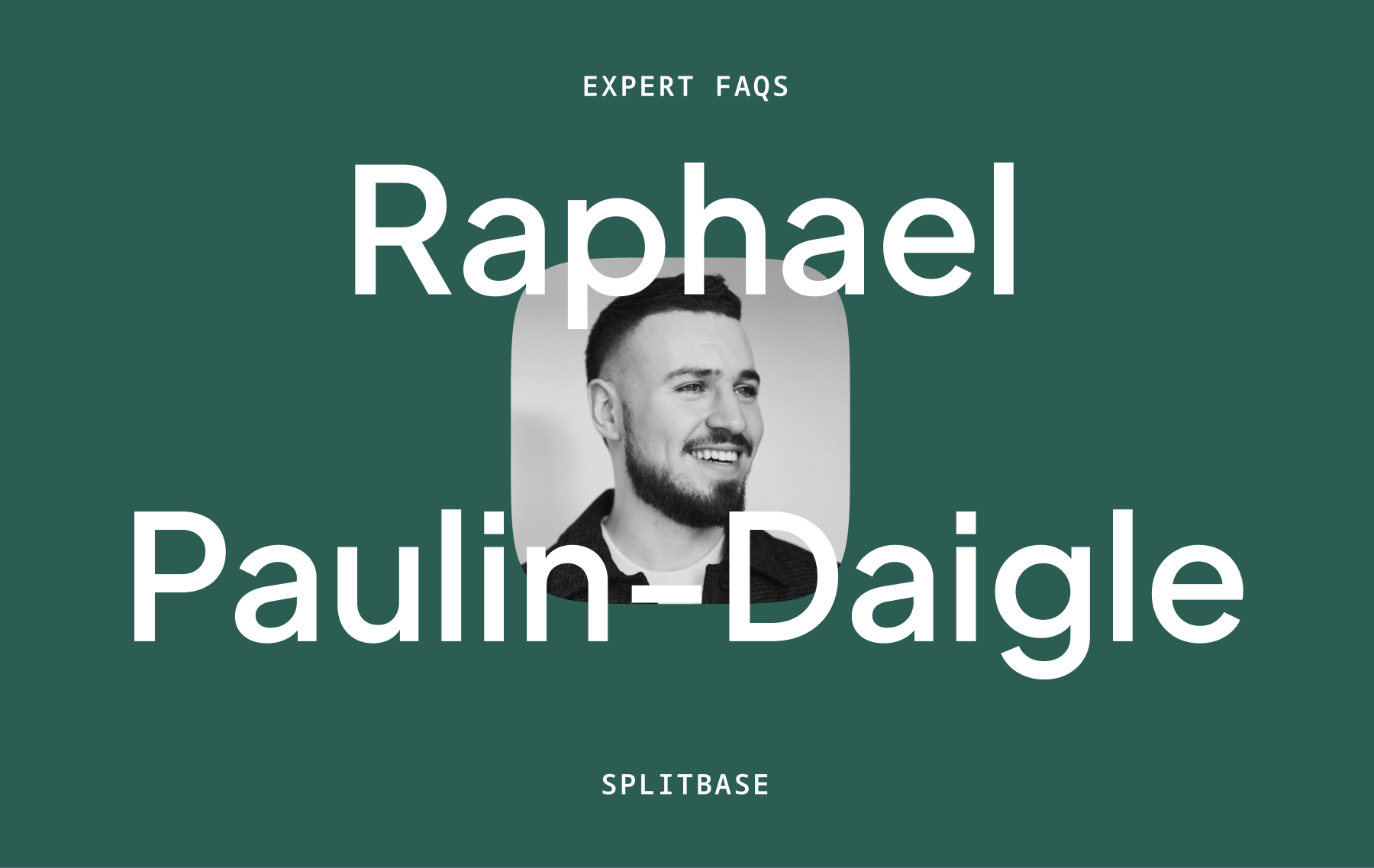
To unpack what really goes wrong, and what the brands quietly compounding revenue every quarter do differently, we sat down with Raphael Paulin-Daigle.
Meet the expert
Raphael is the founder and CEO of SplitBase, an ecommerce CRO agency working exclusively with 8 and 9-figure DTC brands like Dr. Squatch, Kiehl's, Amika, and Transparent Labs.
He's been running optimization programs for over a decade and also hosts the Minds of Ecommerce Podcast. After so many years inside CRO programs, he keeps seeing the same expensive mistake: brands feel they know which pages to optimize, and the data almost always says they're wrong.
Here's what he had to say.
Why most DTC brands end up testing the wrong pages
There's a difference between the pages people think need optimizing and the pages that truly do.
Most teams default to the obvious candidates: homepage, a landing page, maybe the main product page.
They pull up analytics, sort by traffic, and start there. That's not a terrible starting point. Pages with the most traffic usually are worth optimizing. But it's incomplete, because traffic alone doesn't tell you where you're losing money.
The step almost nobody does, and the one I think is the real first step of conversion optimization, is a funnel breakdown.
Look at each page in your funnel and how each page feeds into the next.
- When people land on the site, where do they land?
- Of those, how many go on to view a product?
- How many add to cart?
- How many proceed to checkout?
- How many complete the purchase?
Without that breakdown, you never identify where the biggest leak in your funnel really sits.
You just have a vague sense of which pages "should" be tested. You might be running a few good tests on pages that genuinely need work, but you're probably also burning half your testing budget on pages that don't matter, and missing the biggest opportunities entirely.
How to figure out which pages are truly costing you the most revenue
Do the funnel breakdown, then segment it.
Even when you've done the breakdown, the stage-by-stage numbers are still aggregates. They mask a lot, so you have to break them down further:
- By device. You might think a step is fine because the average looks fine. Split desktop and mobile, and you'll often see that step performing great on desktop and terribly on mobile. That points to a mobile-specific issue, and the priority shifts to mobile-specific experiments on that page.
- By channel. People from Google paid might move through your funnel beautifully, while people from paid social hit a wall at a specific step. That changes your roadmap entirely.
- By segment combination. Sometimes the question isn't "which page is costing me the most revenue." It's "which page for which segment."
That last one matters more than people realize.
You might find organic traffic lands on a collection page just fine, but barely any of those visitors make it to a product page.
Meanwhile, paid social gets to the product page no problem, but nobody adds to the cart. That gives you two priorities and two tracks.
For organic, the goal is to increase product page views. For paid social, the goal is to improve the add to cart rate.
Same site. Two completely different optimization roadmaps.
The overlooked opportunity in collection pages
For brands with many SKUs, collection pages are often the biggest lever in the funnel. Nobody talks about them, and that's exactly why the opportunity is still there.
Collection pages look functional. Grid of products, a few filters, very little text.
There's nothing obvious to "optimize." But here's what I've watched happen for ten years.
Brands with hundreds or thousands of products (apparel, eyewear, furniture) often win more from collection page work than from PDP work.
The reason is structural.
When you sell thousands of products, you can't customize every product page in depth.
You can't write a unique, voice-of-customer description for 2,000 SKUs. So PDP testing for those brands has to focus on what works across every product, which puts a ceiling on what you can do.
Meanwhile, the real challenge for any brand with a big catalog is product discovery.
People buy because they liked the product, found it, and felt good about it. If a visitor can't find one they like, you could have the best PDP on the planet and it wouldn't matter.
The question becomes: if I sell hundreds of eyeglasses, how do I get this visitor in front of a frame they love as fast as possible?
That's the collection page work.
- Product discoverability.
- Merchandising.
There are a hundred levers, and the ones worth pulling depend on the brand and the catalog:
- Sort order. Which products do you show first, and does that shift by segment?
- Product card design. Which photos lead? How many products per row do you surface value props inside the grid?
- Filters. Which appear, in what order, and which ones do shoppers use to narrow down?
- Assisted shopping. Would a quiz help visitors find the right product faster?
Step one is always behavioral data. Heatmaps, scrollmaps, analytics. Which filters do people use?
How many products do they view before purchasing? Look at the inputs before picking the lever.
For brands with deep catalogs, collection pages are where the biggest unclaimed wins tend to sit. Most teams just don't think to look there.
The page brands waste testing budget on most
Any page that doesn't get enough traffic, or any page that isn't truly leaking in the funnel breakdown.
This is brand-dependent, but the pattern I see most often involves the homepage getting more attention than it deserves. Marketing teams at 8 and 9-figure brands are usually sharp enough with analytics that this isn't constant, but it still happens.
Homepages are important, and for some brands, the homepage truly is one of the top pages to optimize. But if you're sending most of your paid and organic traffic straight to product, collection, or landing pages, the homepage becomes a secondary target.
It shouldn't be eating the bulk of your testing budget just because the team treats it as the front door.
I've worked with brands pouring testing effort into their homepage while their collection pages went completely untouched.
When you added up the traffic across all those collection pages, they were collectively pulling more visitors than the homepage ever did.
The Collection page work was the biggest lever on the site, and nobody on the team had looked at it.
Which pages should you prioritize instead
Prioritize the pages where the funnel breakdown shows the biggest leak. That's the first filter.
But there's a second filter on top of that, which most brands ignore: acquisition cost.
Every brand right now is fighting the Meta and Google algorithms, watching CAC climb and ROAS shrink.
So if you have two pages that get roughly the same volume, but one gets organic traffic, and the other gets paid traffic, prioritize the paid page.
You're paying real dollars to push visitors to that paid page. Every drop-off is paid traffic walking out the door. Optimizing it directly improves your marketing efficiency in a way an organic page can't.
Ideally, you optimize across every high-traffic page with a real conversion weakness. But when you have to pick, the pages you're spending money to drive traffic to should be at the top of the list.
How to prioritize a testing roadmap
Look at your funnel in reverse.
You can have 100 test ideas in a backlog. The job of prioritization is figuring out which of those has the highest potential to move revenue, either by improving conversions for the largest pool of customers or by fixing the biggest leak in the funnel.
Most people instinctively want to start at the top, optimizing the homepage to drive more visitors to view products.
My hard-won instinct is the opposite. Start at the end.
Look at cart abandonment. If a meaningful percentage of people add items to their carts but do not complete the purchase, those are visitors who have essentially decided to buy.
They picked the product, they accepted the price, they're one step away.
Something specific is in the way. Shipping cost, account creation, or a payment friction point.
Resolve that one objection, and those people convert, because the decision was already made.
So, a simple rule: find the biggest leak in your funnel. If you have leaks of similar size, start with the one closest to the purchase.
After that, use a prioritization framework.
I'll be honest, I'm not a huge fan of PIE or ICE scoring. They're better than nothing, but they're highly subjective.
If I ask you to rate a test idea's impact on a scale of 1 to 10, what does an 8 mean? Two people will score the same idea completely differently, and neither will be wrong.
At SplitBase, we use our own scoring framework. We look at how many data points support the hypothesis and what type of data (qualitative, quantitative, heuristic studies, past learnings).
Each carries a different weight. Then we tie it back to the funnel breakdown, and we estimate the dollar impact. If we lift this step of the funnel by 3%, how much more annual revenue does that produce?
Once you have a dollar amount next to a hypothesis, the right priority becomes obvious.
What should brands do once they start testing the right pages?
They keep researching once they've identified the right page.
At SplitBase, we use an optimization methodology we call the 3Ps. The first P is patterns, and that's where the research lives. Analytics, heatmaps, scrollmaps, and behavioral data.
Most teams do the right thing with analytics. They use it to pick the right pages. Funnel breakdown, find the leak, pick the page to focus on. Good. The mistake is that the data work stops there.
Because once you've found the right page, you still have to find the right thing to test on that page. And if all you've done is analytics, you don't have the full picture. You know where the problem is, but you don't know why.
So the second pattern we look at is the voice of the customer.
Surveys, review mining, ad comments, on-site polls, and usability testing where needed. Why is this page underperforming? What's the actual objection or friction the visitor is hitting?
This is the step brands skip.
They use analytics to find the page, then jump straight into testing because skipping research feels faster.
If you give me a product page and ask me what to test without any voice-of-customer data, I can hand you 100 random test ideas. Maybe one will be close to the real issue. The rest run you in circles.
You spend three months testing things on the right page that don't move the metric, conclude CRO doesn't work, and lose faith in the program. When the real story is that you skipped the research step that would have told you what to test..
How long does it take to see real revenue impact
Assuming you're running the program right (following a methodology, identifying the right pages, then the right things to test on those pages), results land somewhere between a couple of weeks and three months.
Sometimes the gap in the funnel is clear, the research points to a specific fix, the test runs, and the lift shows up in the first few weeks.
Sometimes it takes three months to find the right combination on a tougher page.
Forget the idea that you'll start CRO on Monday and double your conversion rate by Friday.
Outside of a major bug fix, that doesn't happen. If that's the expectation you're bringing to CRO, you'll be disappointed, and you won't have the mindset to do the work that compounds over time.
Treat it like SEO or content marketing. The more reps you run, the more your tests compound and the sharper each next hypothesis gets.
The bigger payoff comes from running the program for a year and watching the wins stack.
.jpg)