The best A/B testing tools in 2026

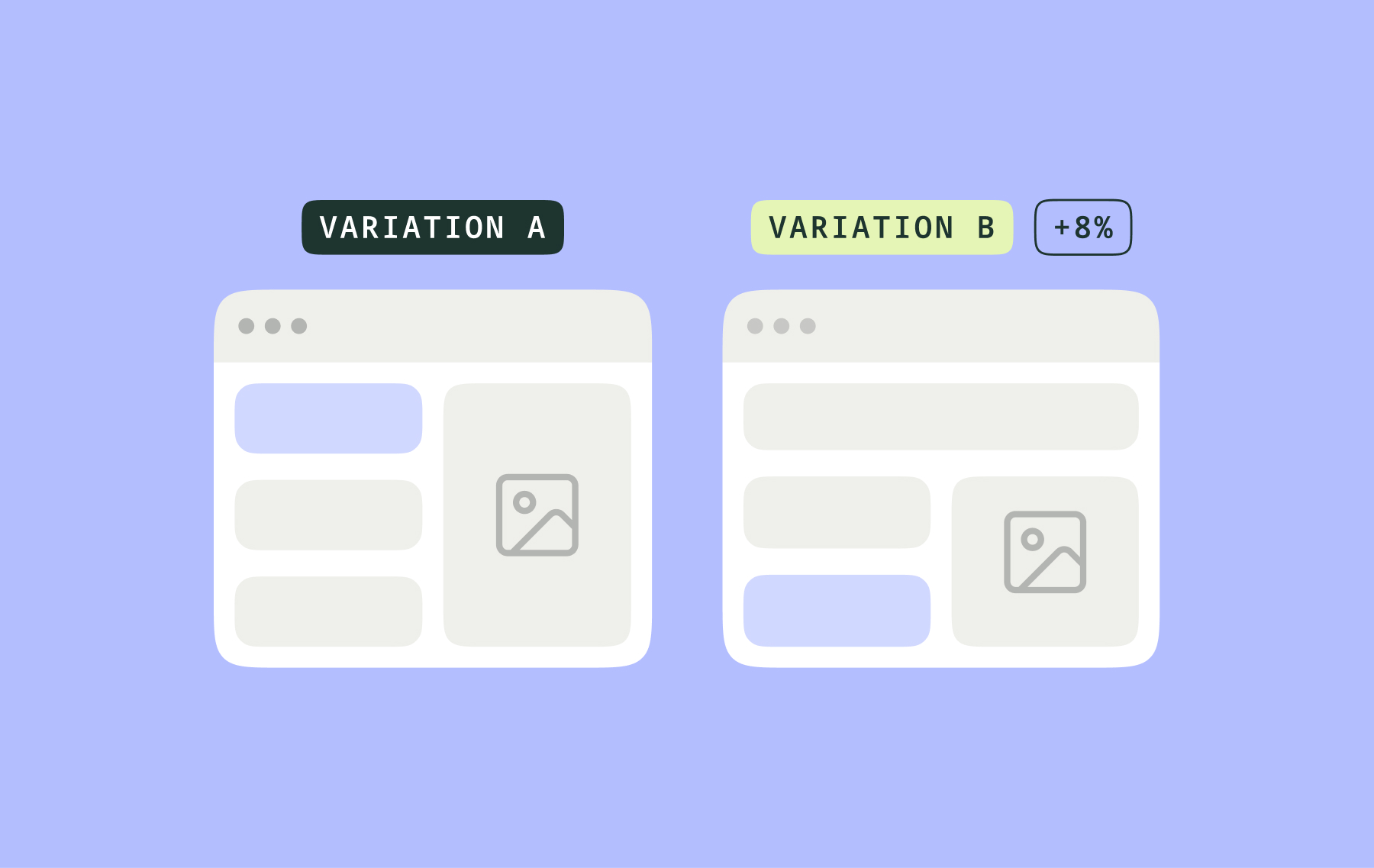
Experimentation has changed dramatically over the past few years.
Not long ago, A/B testing was mostly about changing a button colour or testing a headline.
Today, experimentation spans across websites, mobile apps, pricing, product features, personalization, onboarding flows, AI-generated experiences, and feature rollouts.
As experimentation has matured, so too have the needs for the tools that support it.
But not every platform is built the same.
Some platforms are best for marketers who want to launch website tests quickly. Others focus on product teams running feature flags and server-side experiments. In contrast, some platforms prioritize privacy and governance, while others specialize in warehouse-native analytics or AI-assisted workflows.
That's why asking "what's the best A/B testing tool?" isn't really the right question anymore.
In today’s testing environment, a better question is: which platform best fits the way your team experiments?
To best answer this question, you need to look at your experimentation goals, your technical resources, your website traffic, and how mature your experimentation program is.
To give you a running head start, this guide compares the leading experimentation platforms in 2026, explains where each one excels, and helps you narrow down the right choice for your organization.
Let’s jump in.
What to look for in an A/B testing tool in 2026
People often ask me which experimentation platform I recommend.
In true CRO style, my answer is almost always the same: it depends.
There's no universally "best" platform.
Because the right tool for a SaaS company shipping product features every week may be completely wrong for an e-commerce retailer running marketing campaigns.
But, “it depends” isn’t really that helpful of an answer if you don’t narrow down what it depends on.
So to help you establish the criteria to determine the best testing platform for your needs, I recommend you ask yourself and answer these nine questions:
1. Who will be running the experiments?
After reviewing hundreds of A/B tests over the years, I've found the biggest barrier usually isn't statistics. It's how difficult the platform makes it to launch experiments in the first place.
If you're a marketer, you may lean towards a simpler platform that offers a visual editor and lets you launch tests without waiting for engineering resources. A visual editor enables you to make simple interface changes, copy updates, tweak landing page designs, and rollout promotional campaigns in a visual, easy-to-use fashion.
On the other hand, if you're on a product team, your needs are very different.
You'll likely want to have server-side experimentation capabilities, access to APIs, and the flexibility to test functionality through feature flags long before updates are released to every customer.
The more closely a platform matches the way your team already works, the more likely it is your experimentation program will succeed.
2. What kind of traffic do you have?
Not every experimentation platform is designed for every size of business.
If your site receives relatively little traffic, under about 10 thousand visitors per month, you'll want a platform that provides clear guidance around sample size and statistical power. Running underpowered experiments wastes time and often leads to misleading conclusions. So you’ll want a platform that helps you design trustworthy experiments based on the sample size restrictions you may have.
{{blue-block-1}}
If you’re part of a larger organization that’s blessed with a lot of traffic, with hundreds of thousands of visitors per month, your team might instead prioritize scalability, faster experimentation cycles, and the ability to run multiple tests simultaneously without interference.
It’s also important to realize that the amount of traffic also affects pricing of most testing platforms. Many vendors charge based on monthly visitors or sessions, so costs can increase significantly as your business grows.
3. How does the platform analyze results?
One of the most overlooked differences between experimentation platforms is how they calculate winners.
Some platforms use Frequentist statistics, while others rely on Bayesian methods. A growing number support both.
Neither approach is inherently better.
What's important is understanding how your platform reaches its conclusions and making sure your team knows how to interpret the results correctly.
A sophisticated statistics engine isn't particularly useful if it encourages teams to draw the wrong conclusions.
4. Does it integrate with your existing technology stack?
Experimentation shouldn't create another silo within your organization.
The best platforms fit naturally into the tools your organization already relies on, whether that's your analytics platform, customer data platform, CRM, data warehouse, or feature management system.
The easier your systems work together, the easier it becomes to make experimentation part of everyday decision-making.
So as part of your evaluation process, you’ll want to ensure the testing vendor you’re considering plugs into the platforms you’re already using.
5. Does it fit with your budget, and is it easy to use?
Pricing matters, but value matters more.
The least expensive platform isn't always the best investment, and the most expensive one may have capabilities you'll never use.
Instead of assessing a platform based on features alone, determine if your team will actually use the platform and the features offered.
Because a powerful platform that is cumbersome and hard to use doesn’t provide much of an advantage.
So look beyond feature lists.
Instead, do a demo of the platform ahead of time to assess questions like:
- How quickly can your team learn the platform and build a test?
- How easy is quality assurance?
- Can experiments be launched independently, or does every change require developer support?
The best experimentation tools reduce friction and will allow the team to spend time learning from customers instead of needing to learn how to use the software.
6. What about AI capabilities?
Almost every experimentation platform now includes some form of AI.
You need to know how AI is being used, integrated, and updated within the platform.
The best platforms use AI to speed up repetitive work, like generating hypotheses, creating variations, summarizing results, or identifying optimization opportunities.
{{pink-block-1}}
7. Does the platform support feature experimentation?
Experimentation shouldn’t just be limited to websites.
Your product team may want to test new features behind feature flags, gradually roll out functionality, and validate ideas before exposing them to every user.
If experimentation is becoming part of your product development process, make sure the platform supports feature management alongside traditional A/B testing.
For example, Kameleoon’s feature flag functionalities enable you to easily roll out new features with confidence.
8. Can it meet your privacy and compliance requirements?
For organizations operating in regulated industries, meeting privacy, security, and compliance regulations is crucial.
If your business must comply with regulations such as GDPR or HIPAA, confirm that the platform supports your organization's data governance requirements before making a decision.
This upfront research may eliminate some vendors immediately and save you considerable time during the evaluation process. Kameleoon provides industry-standard security features like end-to-end encryption and is ISO 27001 and SOC 2 certified.
9. What do other experimenters say about the platform?
One final piece of advice: don't rely solely on vendor websites.
Read independent reviews, talk to current customers, and ask to see live demos.
Choosing an experimentation platform is like deciding to get into a committed relationship.
Once you lock into an experimentation platform, you’re not going to want to change it since it becomes a repository housing your testing data and experimentation history.
So to help you make sure you’re making the right decision, be sure to understand important and often understated factors like:
- What's included in support
- How responsive the customer success team is
- How pricing changes as your traffic grows
You can check out the independent platform comparison guides created on Conversion Stash and ABTestResult.com to help you answer the questions, see verified review ratings, and filter through the many experimentation platform options out there.
Choosing an experimentation platform isn't just about selecting software. You're investing in the foundation of your experimentation program. Taking the time to evaluate your options carefully will pay dividends for years to come.
With this criteria in mind, here’s a list of vendors by the:
- Leading enterprise-level experimentation platforms
- Best overall experimentation platforms
- Strongest feature flagging and product experimentation platforms
- AI-powered experimentation
Keep in mind, the experimentation landscape changes quickly. New platforms emerge, established vendors add AI capabilities, and acquisitions continue to reshape the market.
However, as of June, 2026, here are the top experimentation platforms for you to consider:
Leading enterprise-level experimentation platforms
The leading enterprise experimentation platforms combine web experimentation, feature experimentation, personalization, prompt-based (AI) experimentation, and robust analytics within a single ecosystem.
While they all share these core capabilities, each has its own strengths.
The platforms below represent some of the strongest enterprise experimentation solutions, each offering a different balance of functionality, scalability, and ease of use.
Kameleoon
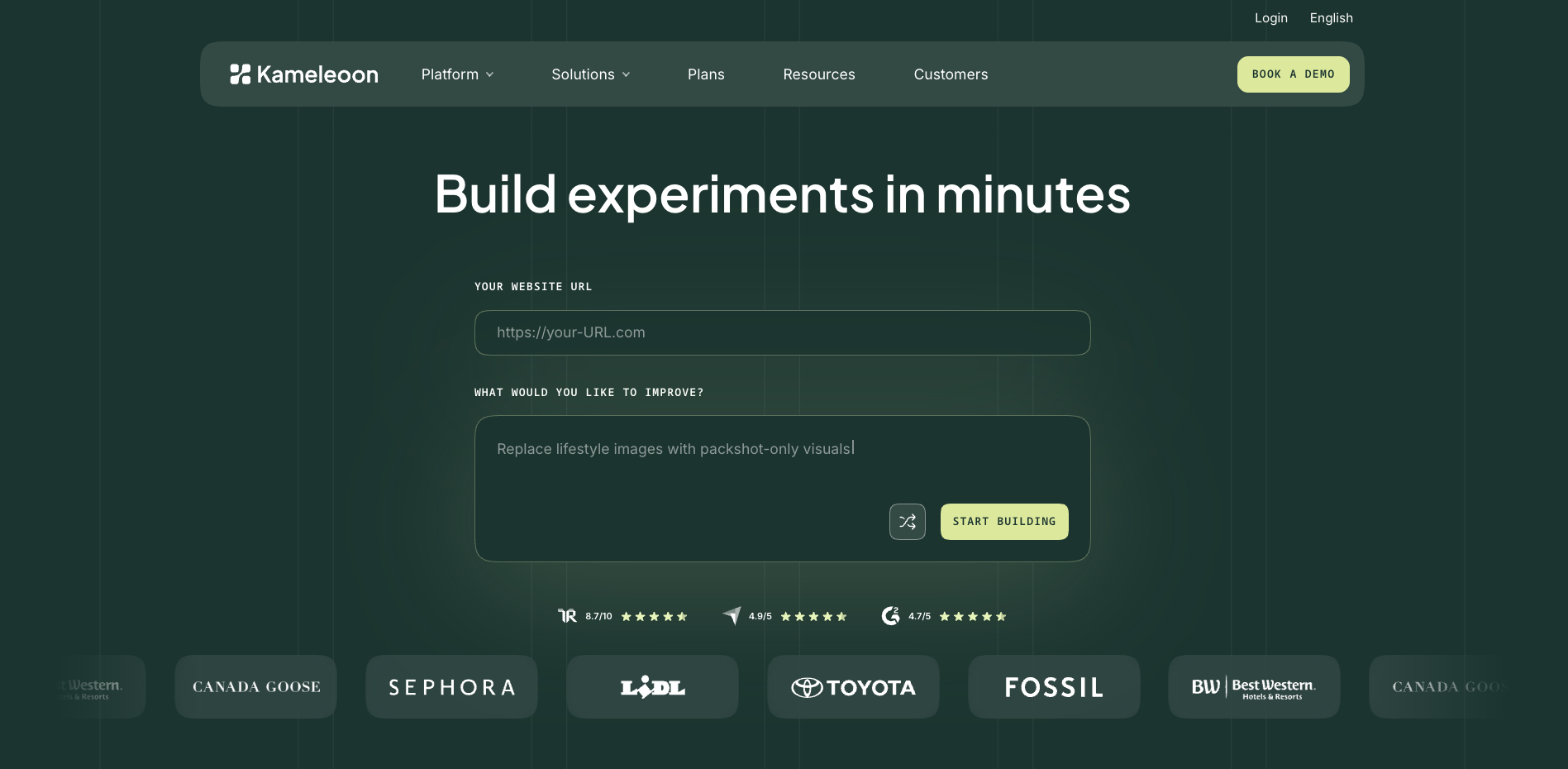
Kameleoon is a versatile experimentation platform that lets you easily build experiments in minutes.
Kameleoon is currently leading the market with an AI-assisted, prompt-based experimentation platform called PBX.
However, the platform also offers web experimentation, feature experimentation, personalization, and strong privacy capabilities into a single solution.
Rather than separating marketing and product experimentation, it enables both teams to work from the same foundation while maintaining governance and data quality.
Strengths:
- Strong AI-assisted workflow capabilities
- Comprehensive experimentation platform spanning web, product, and feature experimentation
- Advanced personalization
- Privacy-first architecture with enterprise-grade compliance
- Supports both marketers and developers
- Robust statistical engine
- Excellent enterprise governance
Weaknesses:
- More functionality may mean a steeper learning curve for new users
- Better suited to organizations with an established experimentation culture than teams running only occasional tests
- Enterprise pricing may be out of reach for very small businesses
Overall assessment: Best suited for organizations looking to scale experimentation across multiple teams.
Optimizely
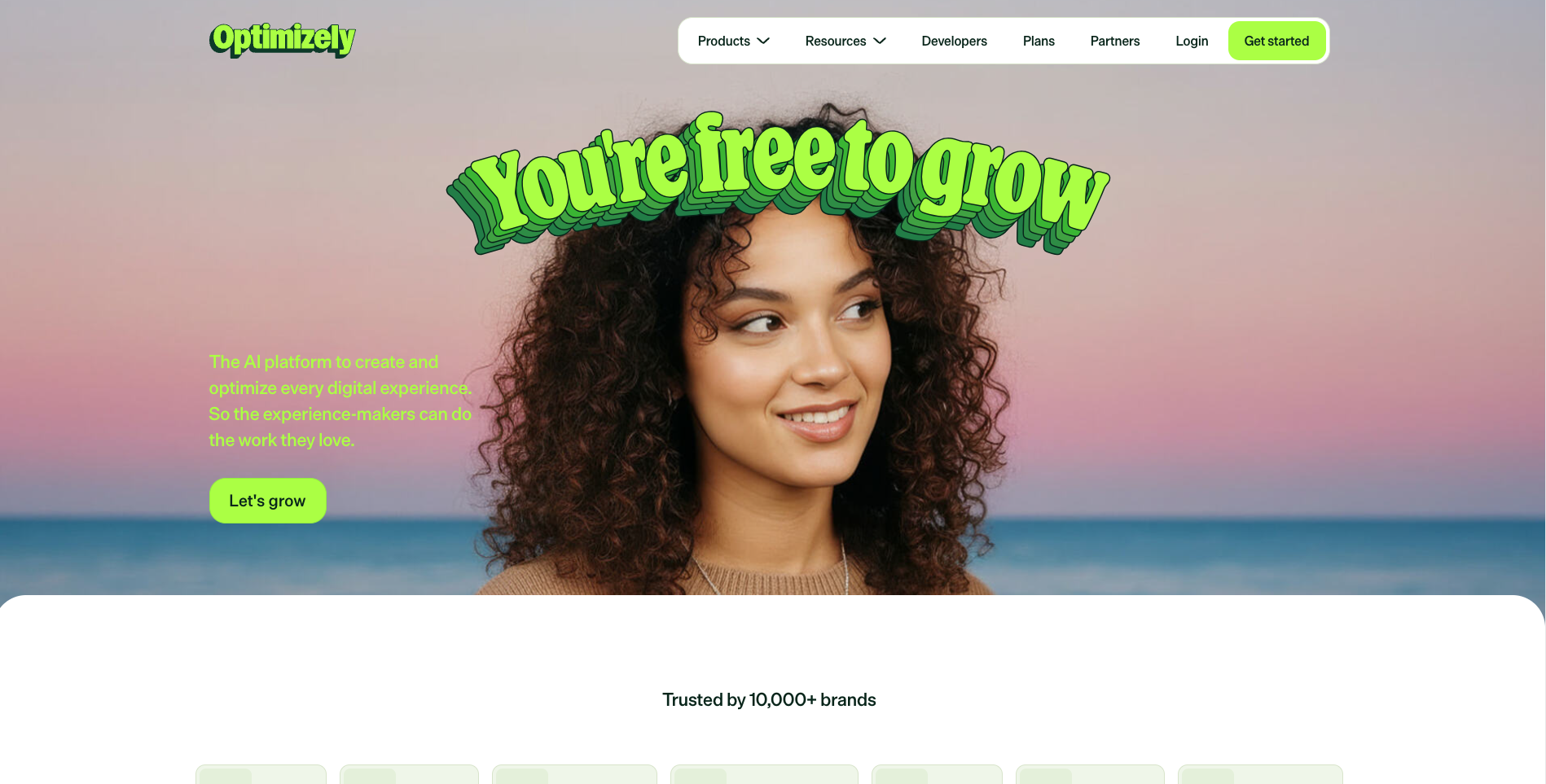
Optimizely recently re-branded but remains one of the most recognizable names in experimentation because of its long-standing offerings in web experimentation, feature experimentation, personalization, and content management.
Strengths
- Mature platform with extensive enterprise capabilities
- Strong support for feature experimentation and progressive rollouts
- Large ecosystem of integrations
- Well-developed AI capabilities through Optimizely Opal
- Excellent documentation and a large user community
Weaknesses
- Often among the most expensive experimentation platforms
- Can require significant implementation and ongoing technical support
- The breadth of products can feel overwhelming for smaller teams
Overall assessment: Optimizely remains one of the strongest choices for large organizations with mature experimentation programs and the resources to support them.
VWO + ABTasty
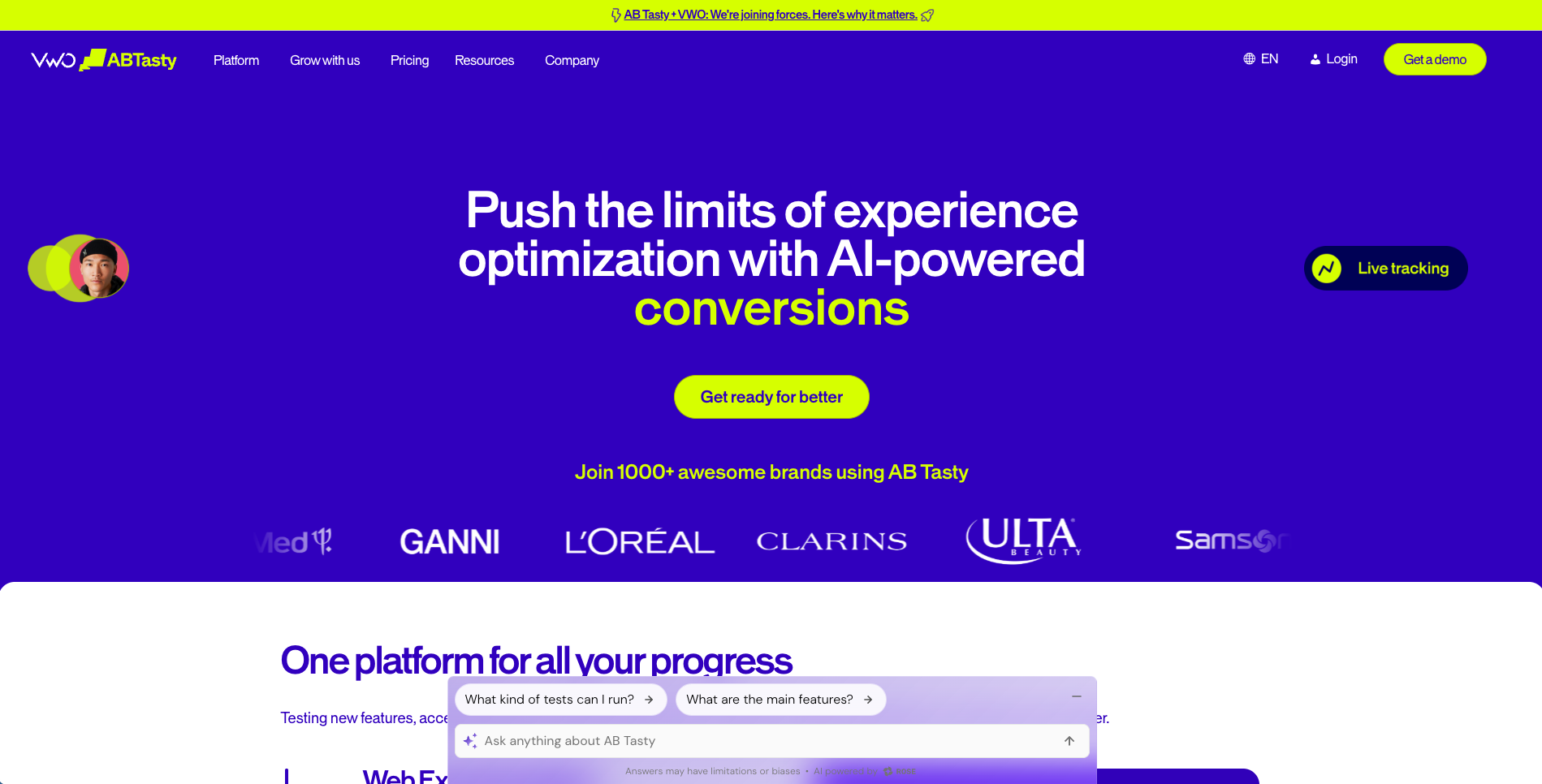
ABTasty has now merged with VWO under the brand VWO ABTasty. Following the acquisition, the combined organization brings together VWO's digital experience optimization capabilities with AB Tasty's experimentation and personalization expertise, creating one of the largest independent experimentation vendors in the market.
Strengths
- Broad portfolio covering experimentation, personalization, behavioral analytics, and product optimization
- Easy-to-use visual editors that reduce the need for developer involvement
- Session recordings, heatmaps, surveys, and experimentation available within the same ecosystem
- Strong personalization capabilities for marketing teams
- Well suited to organizations looking for an integrated optimization platform
Weaknesses
- The long-term product roadmap and platform integration are still evolving following the merger
- Product experimentation capabilities remain less mature than platforms designed primarily for engineering teams
- Larger enterprises may still require more advanced governance and experimentation controls
Overall assessment: The combined VWO and AB Tasty offering provides a compelling all-in-one optimization platform, particularly for marketing-led organizations seeking a balance between usability and breadth of functionality.
Adobe Target
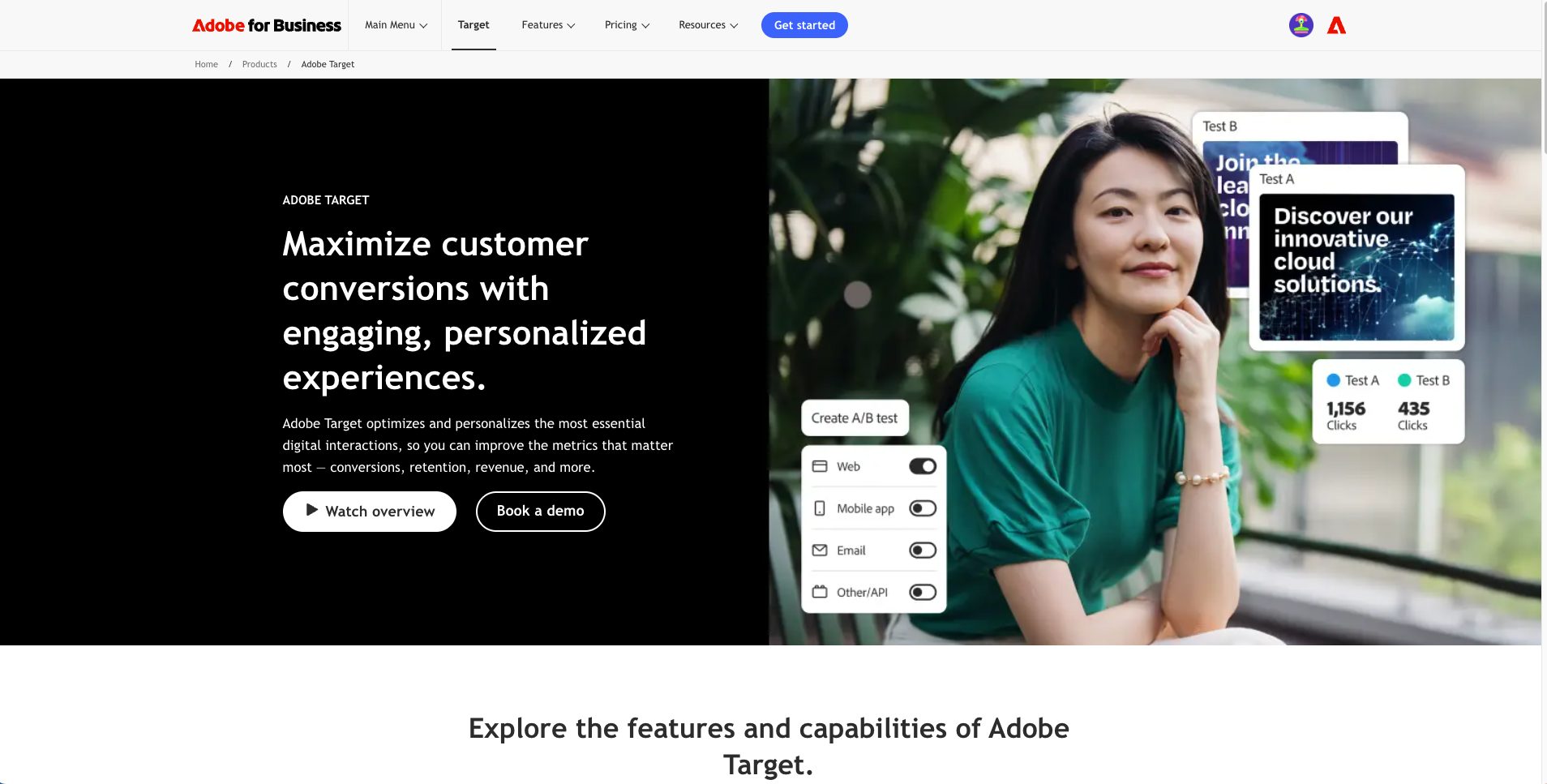
Adobe Target is Adobe's enterprise experimentation and personalization platform, designed to integrate tightly with Adobe Experience Cloud.
Strengths
- Best-in-class integration with Adobe Analytics and Adobe Experience Manager
- Powerful audience segmentation and personalization
- Highly scalable for large enterprise deployments
- Excellent omnichannel experimentation capabilities to experiment across channels
- Strong AI-powered recommendations through Adobe Sensei
Weaknesses
- Steep learning curve
- Premium enterprise pricing
- Delivers the greatest value only when used as part of the broader Adobe ecosystem
- Implementation can be resource-intensive
Overall assessment: Adobe Target is an excellent choice for organizations already invested in Adobe Experience Cloud but is often more platform than smaller organizations require.
Dynamic Yield

Dynamic Yield was first acquired by McDonald’s in 2019 and later by Mastercard in 2021. The company has such acquisition allure because of its progressive personalization capabilities.
Today, under Mastercard, Dynamic Yield serves as an advanced enterprise personalization and experimentation platform that helps organizations optimize digital experiences across web, mobile apps, email, and other customer touchpoints.
Strengths
- Industry-leading personalization capabilities
- Strong support for recommendation engines and customer segmentation
- Omnichannel experimentation across multiple digital channels
- Flexible targeting and audience management
- Particularly well suited to e-commerce, retail, travel, and financial services organizations
Weaknesses
- Personalization is a stronger focus than traditional A/B testing
- Advanced implementations often require technical expertise
- Pricing is generally aimed at enterprise organizations
Overall assessment: Dynamic Yield is an excellent platform for organizations where personalization is just as important as experimentation and customer experience optimization.
Best overall experimentation platforms
Website experimentation remains the foundation of most optimization programs.
If your primary goal is improving websites, landing pages, and digital customer experiences, these platforms stand out:
Kameleoon
Kameleoon combines web experimentation, personalization, prompt-based (AI) experimentation, and feature experimentation within a single platform.
Strengths
- Advanced AI prompt-based tool for quickly building variations
- Powerful visual editor with advanced targeting capabilities
- Combines experimentation and personalization without requiring separate tools
- Strong governance and privacy controls
- Flexible statistics engine suitable for mature experimentation programs
Weaknesses
- More functionality means a steeper learning curve than lighter-weight platforms
- Smaller organizations may not need its full feature set
Overall assessment: An excellent choice for organizations looking to build a sophisticated web experimentation program that can grow into product experimentation over time.
Convert
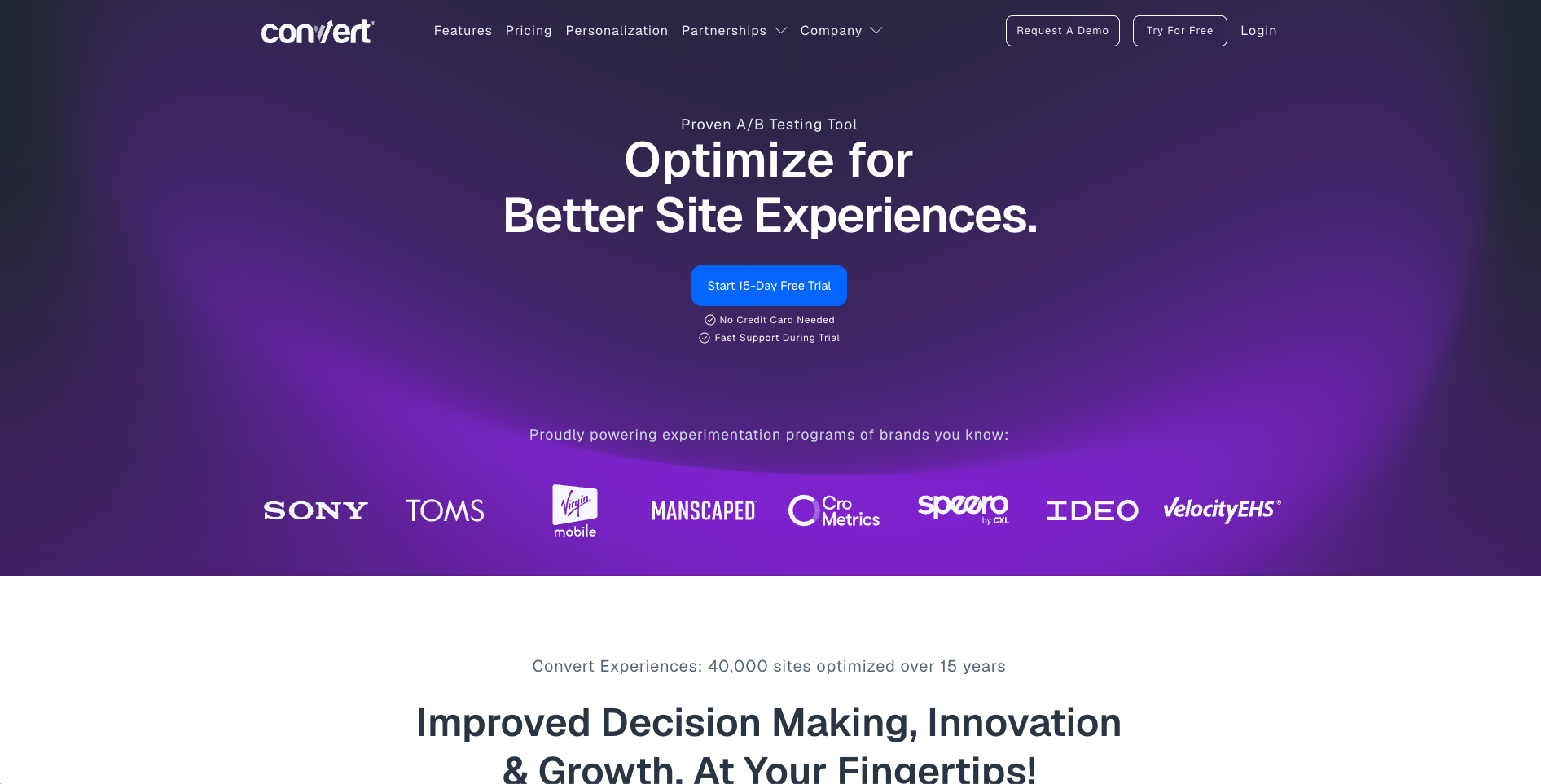
Convert is a privacy-first A/B testing platform designed for organizations that value transparency, reliable statistics, and ease of use.
Strengths
- Strong focus on privacy and GDPR compliance
- Transparent statistical methodology
- Fast implementation and intuitive interface
- Excellent customer support
- Competitive pricing for growing experimentation programs. Provides a 15-day free trial
Weaknesses
- Smaller feature set than larger enterprise suites targeted mostly for SMBs
- Growing but still somewhat limited AI functionality compared with other platforms
Overall assessment: A great choice for organizations focused on reliable website experimentation without unnecessary complexity and an excellent choice to try through a free demo.
VWO + ABTasty
The combined VWO and AB Tasty platform offers experimentation, personalization, behavioral analytics, and customer insights within a single optimization suite.
Strengths
- Combines testing, heatmaps, session recordings, and surveys
- User-friendly visual editor
- Strong personalization capabilities
- Well suited to marketing-led experimentation
- Broad optimization toolkit
Weaknesses
- Product roadmap continues to evolve following the merger
- Enterprise governance features are still developing
- Less focus on customer service than other platforms
Overall assessment: A well-rounded platform for marketing teams looking to consolidate experimentation and behavioral analytics.
Omniconvert
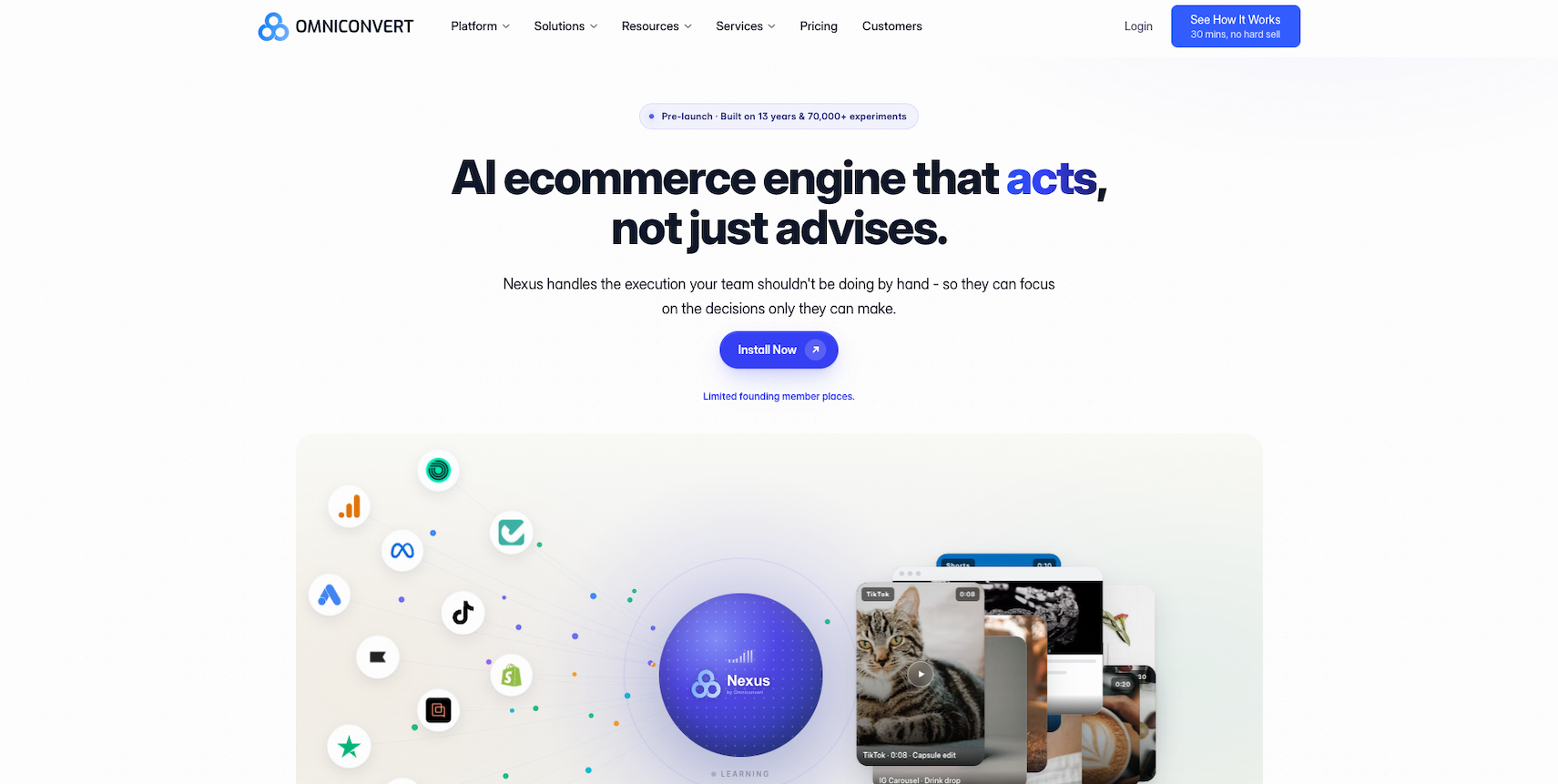
Omniconvert is a customer value optimization (CVO) platform that combines web experimentation, personalization, customer surveys, segmentation, and retention analytics to help e-commerce businesses improve the entire customer lifecycle.
Strengths
- Built specifically for e-commerce optimization
- Strong customer segmentation and RFM analysis capabilities
- Combines experimentation with surveys and customer feedback
- Helps optimize customer lifetime value, not just conversions
- User-friendly interface for marketing teams
Weaknesses
- More focused on e-commerce than broader enterprise experimentation
- Product experimentation and feature flagging capabilities are limited
- Smaller ecosystem and fewer enterprise integrations than larger platforms
- Lacks some of the stability, robustness, data integrity, and customer service of other competing platforms
Overall assessment: Great for e-commerce brands that want to combine experimentation with customer insights and retention strategies rather than focusing solely on A/B testing.
SiteSpect + Montetate
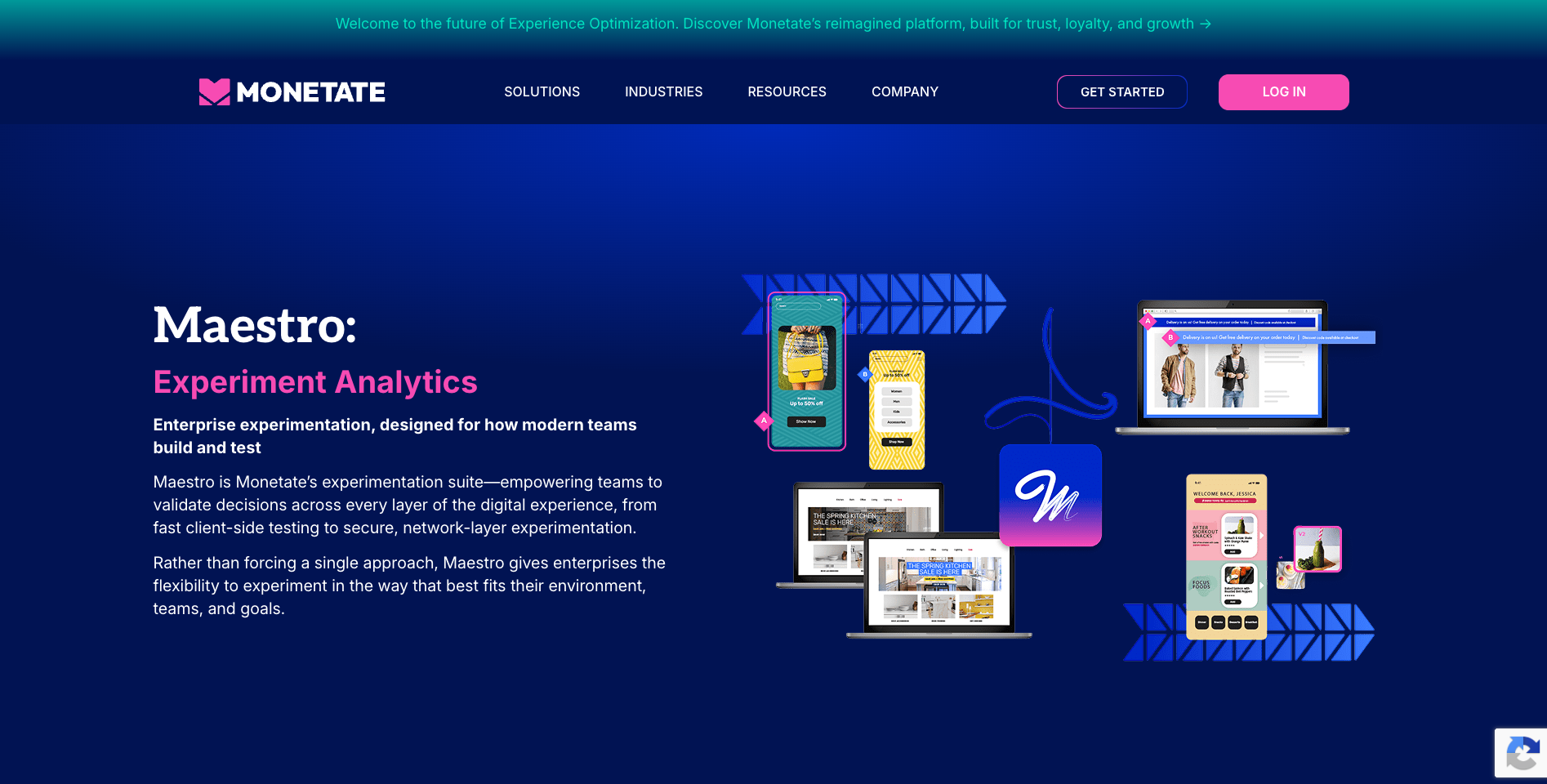
SiteSpect, now acquired by Montetate and rebranded as Maestro, is a full-stack personalization and experimentation platform that helps organizations optimize digital customer experiences through A/B testing, audience segmentation, product recommendations, and AI-driven personalization.
Strengths
- Strong personalization capabilities with real-time audience segmentation
- AI-powered product recommendations and customer journey optimization
- Omnichannel support across web, mobile, email, and e-commerce
- Flexible A/B and multivariate testing for marketing teams
- Well suited to retailers and e-commerce organizations focused on increasing customer engagement and lifetime value
Weaknesses
- Personalization is a greater focus than experimentation, so advanced testing capabilities aren't as extensive as dedicated experimentation platforms
- Best suited to medium and large organizations with established digital marketing programs
- Pricing may be prohibitive for smaller businesses
- Organizations looking for deep feature flagging or product experimentation may require an additional platform
- Integration is a proxy. If the proxy is down, the digital product doesn’t work
Overall assessment: A strong choice for enterprise organizations where personalization is a strategic priority, particularly in retail and e-commerce, and offers a solid balance of experimentation and AI-driven customer experience optimization.
Strongest feature flagging and product experimentation platforms
As experimentation has expanded beyond websites, product teams have increasingly adopted feature flags to validate new functionality before rolling it out to every user.
The platforms below combine feature management with experimentation, helping engineering teams ship software more safely while learning from real user behavior.
Statsig
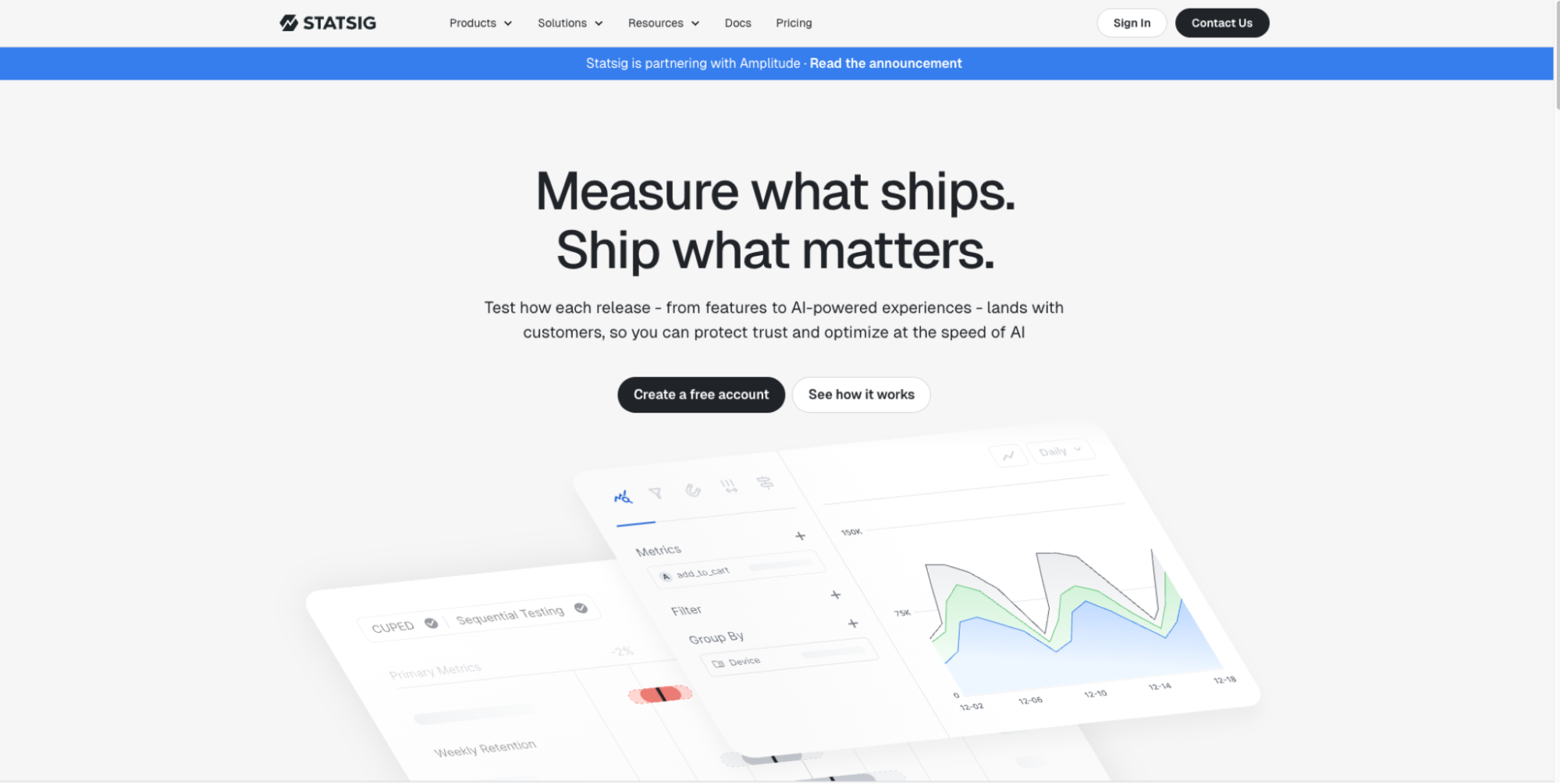
Statsig started as a small, independent experimentation tool. In 2025, it was acquired by OpenAI and is now partnering with Amplitude to bring feature flagging, experimentation, analytics, and warehouse-native data infrastructure.
Strengths
- Excellent feature flag management and progressive rollouts
- Built specifically for modern product and engineering teams
- Strong experimentation and product analytics capabilities
- Warehouse-native architecture integrates well with existing data platforms
- Fast-growing ecosystem with continued investment following its acquisition by OpenAI and partnership with Amplitude
Weaknesses
- Since the Amplitude acquisition, it’s unclear how maintenance will take place
- Less suited to marketing-led website optimization
- Requires technical implementation and developer involvement
- Visual experimentation capabilities are more limited than traditional web experimentation platforms
Overall assessment: A leading platform for product-led organizations looking to combine feature management, experimentation, and analytics within a modern development workflow.
LaunchDarkly
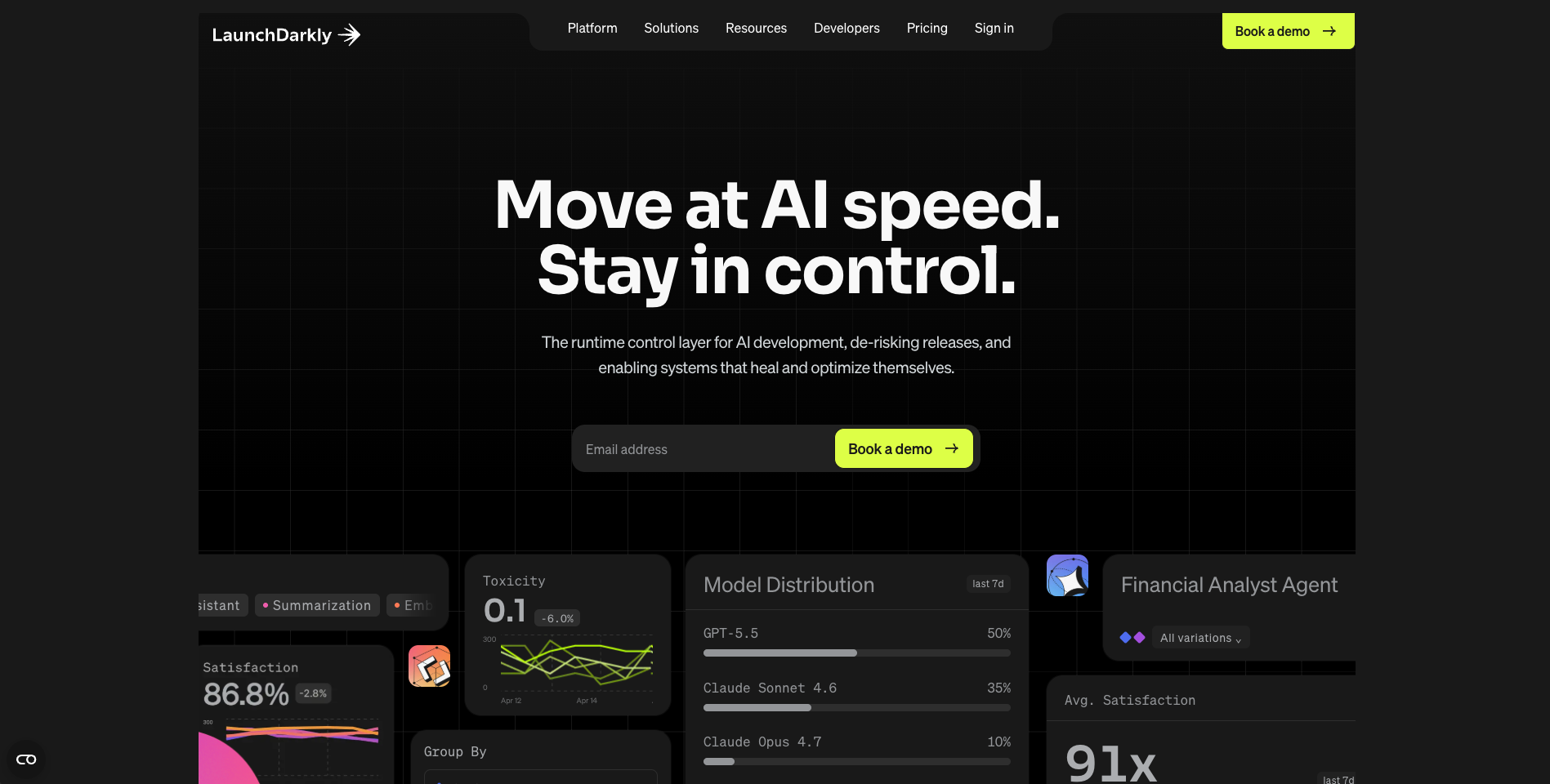
LaunchDarkly is an enterprise feature management platform that enables teams to safely release software using feature flags, progressive rollouts, and experimentation.
Strengths
- Industry-leading feature flag management
- Excellent governance, security, and scalability
- Strong developer experience and SDK support
- Reliable progressive delivery and rollback capabilities
- Widely adopted by enterprise engineering teams
Weaknesses
- Experimentation capabilities aren't as comprehensive as dedicated experimentation platforms
- Limited support for marketing-led website experimentation and lack of AI investments
- Enterprise pricing may be prohibitive for smaller organizations
Overall assessment: An excellent choice for organizations focused primarily on software delivery and release management.
Kameleoon
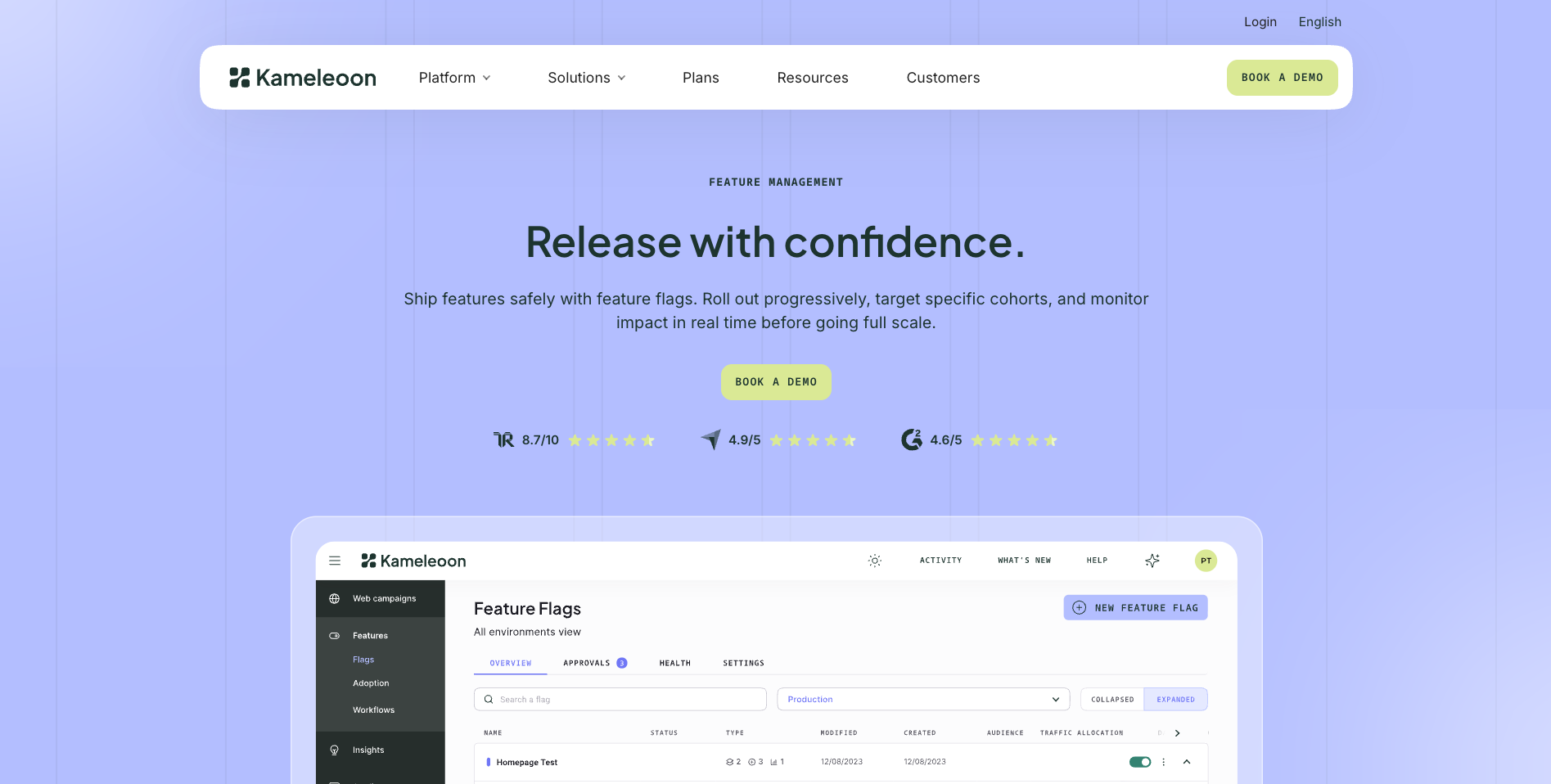
Kameleoon’s feature management tool combines feature experimentation, feature flags, web experimentation, and personalization within a single platform, allowing product, engineering, and marketing teams to collaborate using the same experimentation framework.
Strengths
- Strong feature flagging and progressive rollout capabilities
- Supports both client-side and server-side experimentation
- AI-assisted experimentation and personalization
- Enterprise governance, security, and privacy features
Weaknesses
- Broader functionality creates a steeper learning curve than developer-focused platforms
- Some advanced implementations require engineering support
- Organizations focused exclusively on feature flagging may not need the platform's broader capabilities
Overall assessment: Enables you to seamlessly and safely ship features, progressively roll out updates, target specific cohorts, and monitor impact in real time before going full scale.
GrowthBook
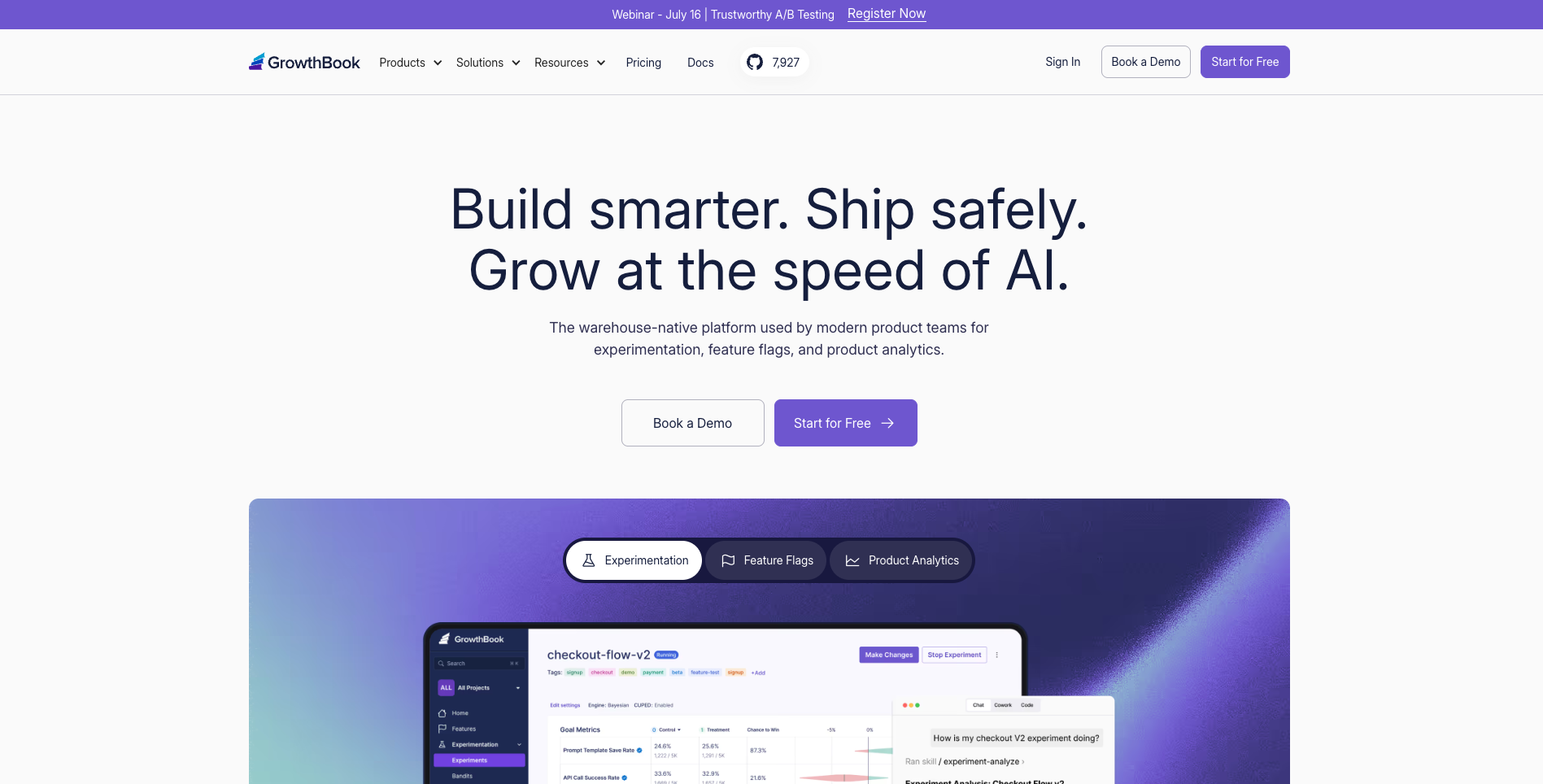
GrowthBook is an open-source experimentation platform that combines feature flags with warehouse-native experimentation, giving engineering teams greater control over their experimentation infrastructure.
Strengths
- Open-source architecture provides flexibility and transparency
- Strong warehouse-native integrations
- Robust feature flagging capabilities
- Transparent statistical methodology
- Active developer community with +7,900 GitHub repositories
Weaknesses
- Requires technical expertise to implement and maintain
- Less accessible for non-technical users
- Limited built-in marketing experimentation capabilities
Overall assessment: An excellent option for engineering-led organizations that want the flexibility of an open-source experimentation platform.
DevCycle
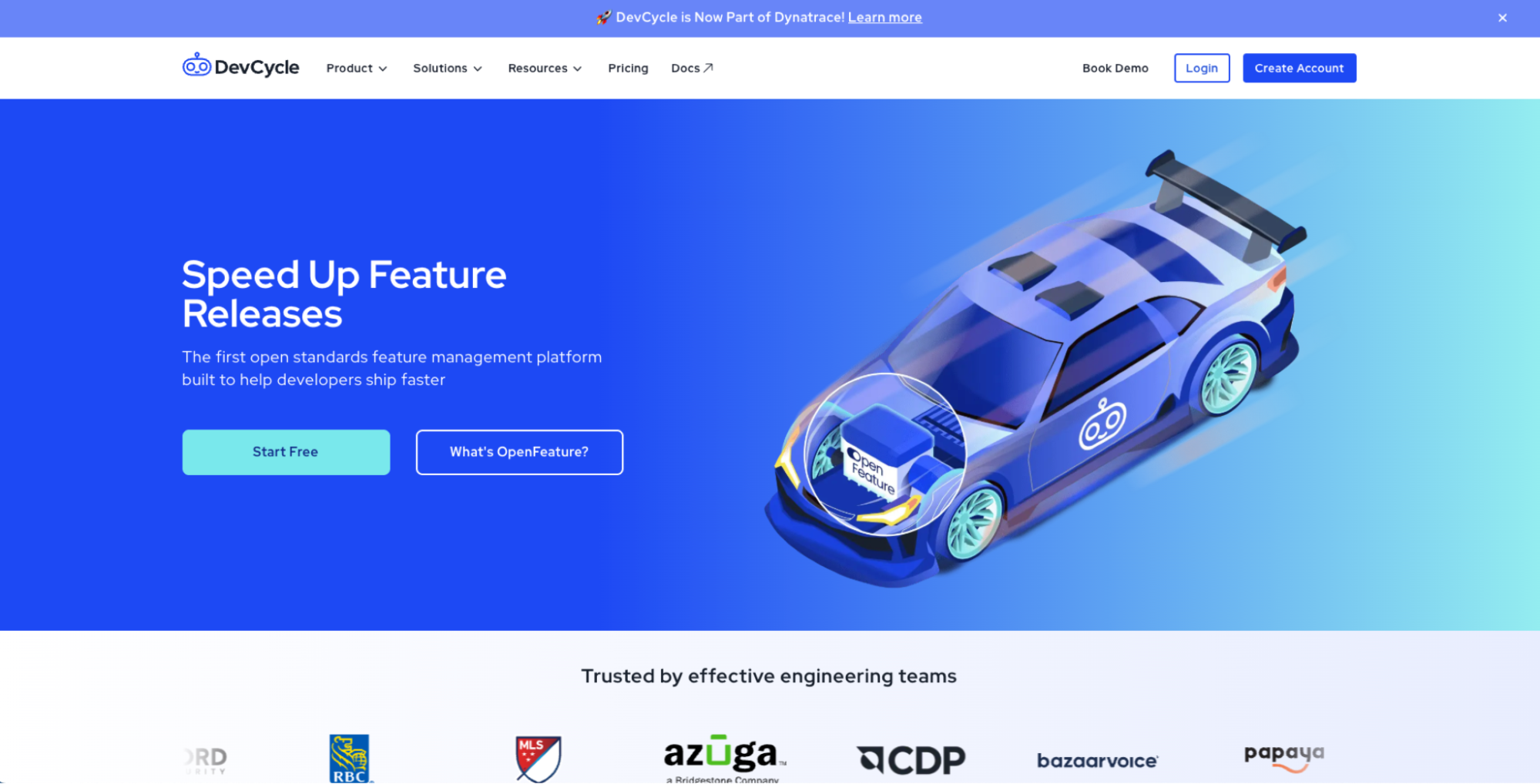
DevCycle, now part of Dynatrace, is a feature management platform designed to help development teams safely release software through feature flags, progressive delivery, and experimentation.
Strengths
- Clean, developer-friendly interface
- Strong support for progressive feature rollouts
- Easy integration into modern CI/CD workflows
- Good governance and feature lifecycle management
- Well suited to agile development teams
Weaknesses
- Smaller ecosystem than more established competitors
- Limited support for traditional website experimentation
- Advanced analytics are less extensive than some enterprise platforms
Overall assessment: Great engineering teams looking for a modern, easy-to-use feature management platform that fits naturally into contemporary software development workflows.
Best AI-powered experimentation platforms
AI is rapidly changing how experimentation teams work.
Instead of spending hours building variants or manually reviewing reports, practitioners can now generate ideas, create experiences, summarize findings, and identify opportunities in minutes.
The most effective automate repetitive work so teams can spend more time understanding customers and designing better experiments.
While nearly every major platform now includes some form of AI, the vendors below have made the most meaningful investments in integrating AI throughout the experimentation workflow
Kameleoon PBX
Kameleoon PBX is an AI-powered experimentation assistant that helps teams identify optimization opportunities, generate hypotheses, create experiment variations, personalize user experiences, and accelerate decision-making across the experimentation lifecycle.
Strengths
- AI integrated throughout the experimentation workflow rather than limited to a single feature
- Generates hypotheses and optimization recommendations based on user behavior
- Supports AI-assisted personalization and audience segmentation
- Helps accelerate experiment creation and analysis
- Built into Kameleoon's broader experimentation platform
Weaknesses
- Advanced functionality is primarily designed for enterprise organizations
- Delivers the greatest value when used as part of Kameleoon's experimentation ecosystem
Overall assessment: One of the most comprehensive AI implementations currently available, using AI to support nearly every stage of the experimentation process.
Optimizely Opal
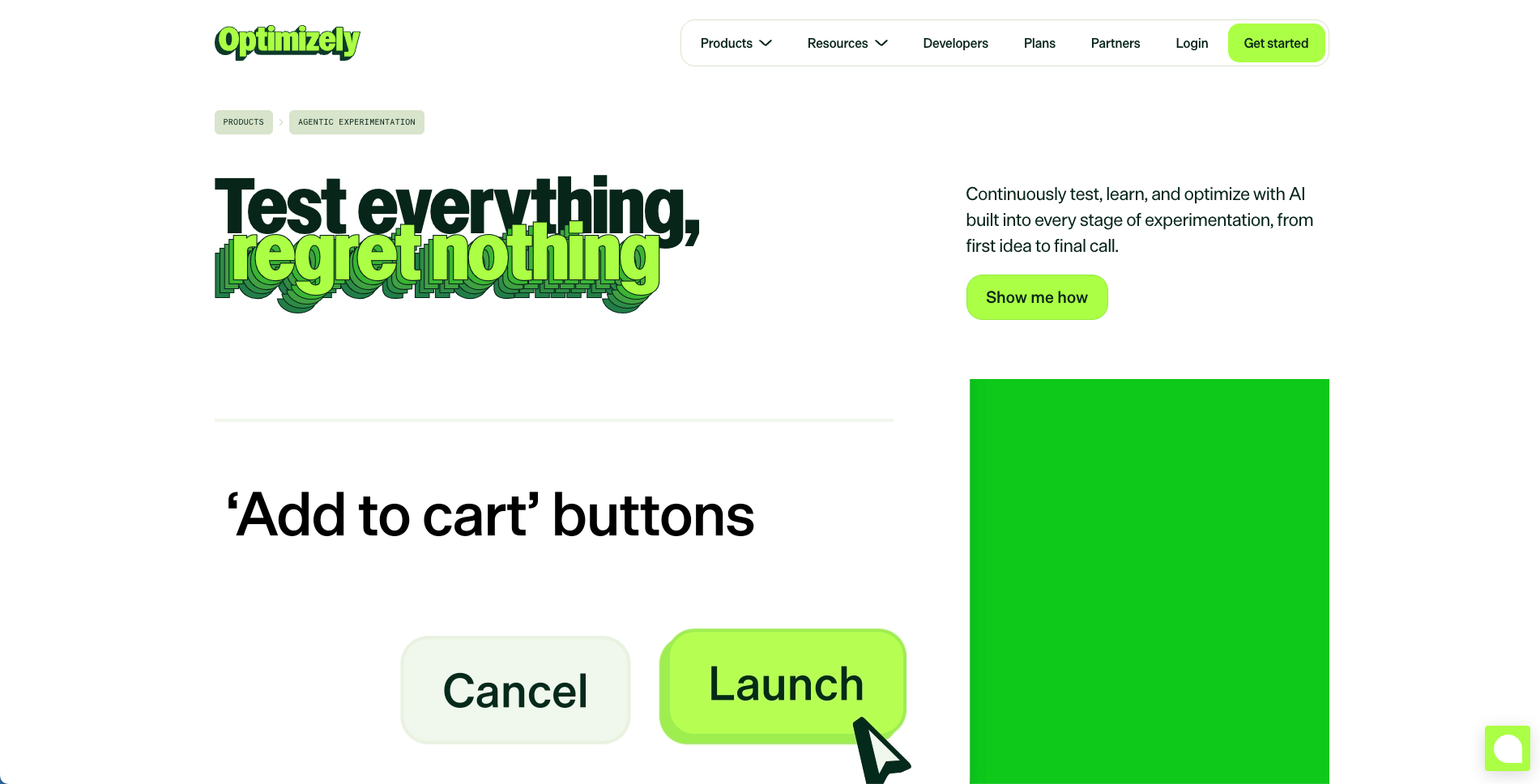
Optimizely Opal is an AI assistant embedded within Optimizely’s Agentic Experimentation platform to help teams plan, build, launch, and analyze experiments more efficiently.
Strengths
- Assists with hypothesis generation and content creation
- Helps automate repetitive experimentation tasks
- Integrated directly into existing Optimizely workflows
- Strong enterprise collaboration capabilities
- Continues to expand alongside the broader Optimizely platform
Weaknesses
- Most valuable for organizations already using Optimizely
- AI capabilities continue to evolve as new features are introduced
Overall assessment: Helps improve productivity across the experimentation lifecycle and is a valuable addition for existing Optimizely customers.
Riggle
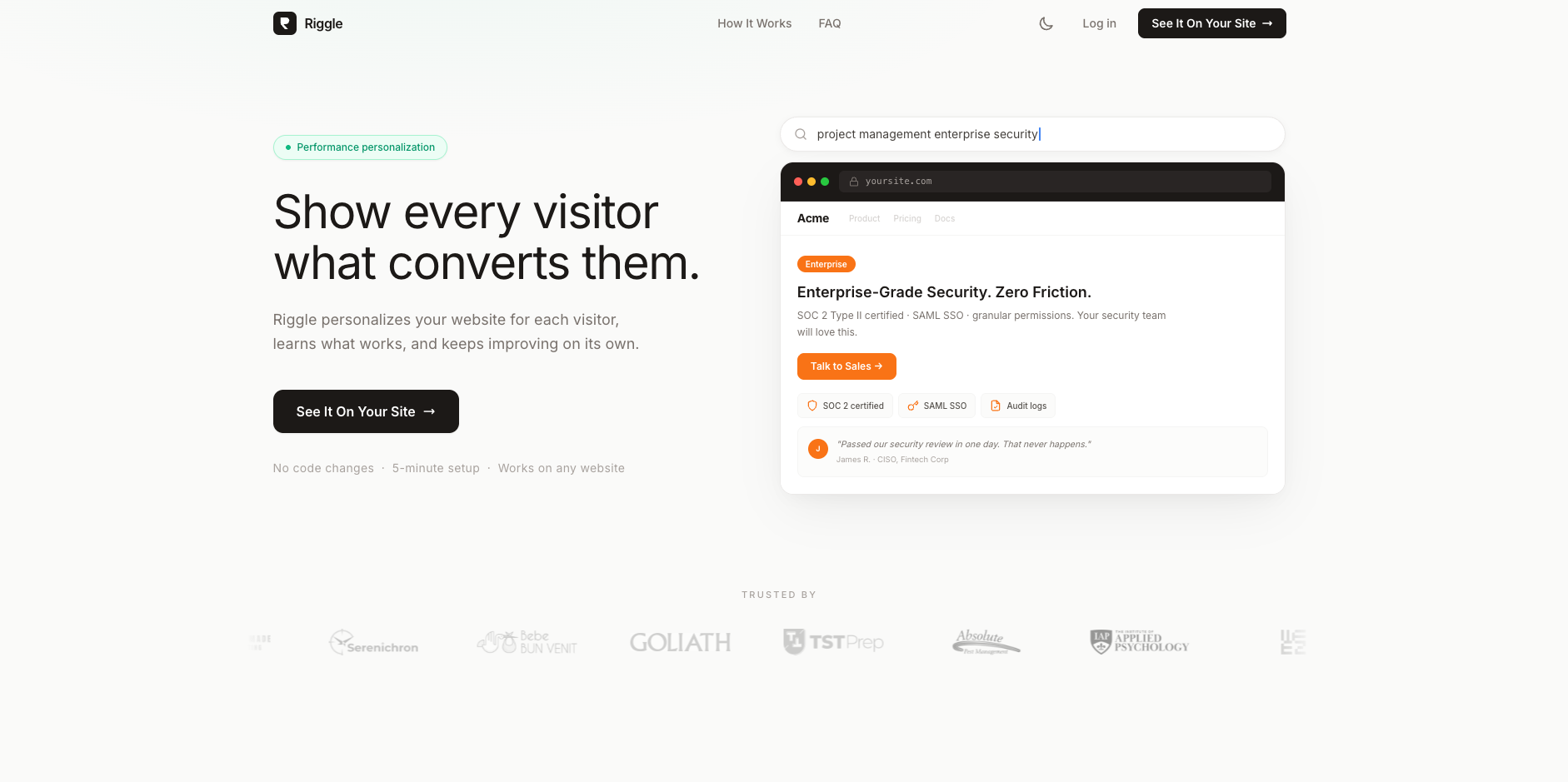
Riggle is an AI-powered personalization platform that helps teams accelerate conversion optimization by automatically generating hypotheses, creating test variations, analyzing experiment results, and identifying optimization opportunities.
Strengths
- Built specifically to streamline the experimentation workflow using AI
- Generates experiment ideas and test variations quickly
- Helps identify optimization opportunities from user behavior
- Reduces the manual effort required to analyze experiment results
- Easy for marketers and CRO teams to adopt
Weaknesses
- Newer platform with a smaller customer base than more established experimentation vendors
- Focused primarily on AI-assisted experimentation rather than broader enterprise experimentation capabilities
- Advanced governance and feature management capabilities are more limited than enterprise platforms
Overall assessment: An innovative platform that uses AI to reduce the time and effort required to run high-quality experimentation programs.
Dynamic Yield
Dynamic Yield is an AI-powered personalization platform that helps organizations deliver individualized customer experiences through experimentation, recommendations, audience targeting, and predictive decisioning across web, mobile, email, and e-commerce channels.
Strengths
- Industry-leading AI-powered personalization
- Sophisticated recommendation engine and predictive targeting
- Supports experimentation alongside omnichannel personalization
- Strong customer segmentation and audience management
- Particularly well suited to retail, e-commerce, travel, and financial services organizations
Weaknesses
- Greater emphasis on personalization than traditional A/B testing
- Advanced implementations often require technical expertise
- Enterprise pricing may be beyond the needs of smaller organizations
Overall assessment: A strong AI-driven personalization platform and an excellent choice for organizations looking to combine experimentation with individualized customer experiences.
Fullstory
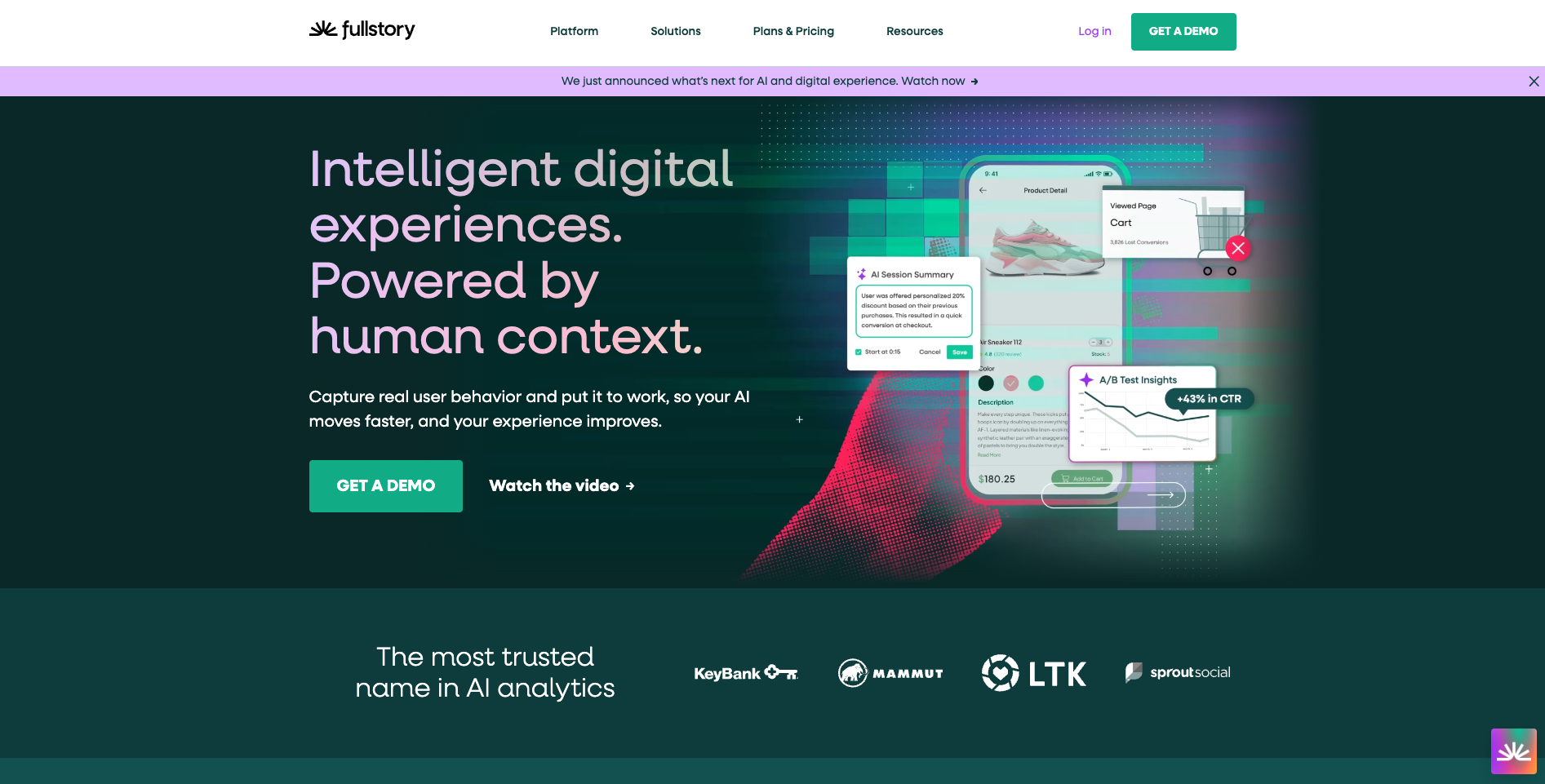
Fullstory is a digital experience intelligence platform that uses AI to surface behavioral insights, identify user friction, and uncover optimization opportunities through session replay, journey analysis, and event analytics.
Strengths
- AI automatically identifies friction points, errors, and usability issues
- Industry-leading session replay and behavioral analytics
- Helps prioritize experimentation opportunities using real customer behavior
- Excellent journey analysis and root-cause investigation
- Integrates with many leading experimentation platforms
Weaknesses
- Primarily an analytics platform rather than a dedicated experimentation platform
- Doesn't include native A/B testing or feature flag management
- Requires a separate experimentation platform to build and deploy experiments
Overall assessment: While Fullstory isn't an experimentation platform itself, its AI-powered behavioral insights make it one of the most valuable tools for identifying what to test next.
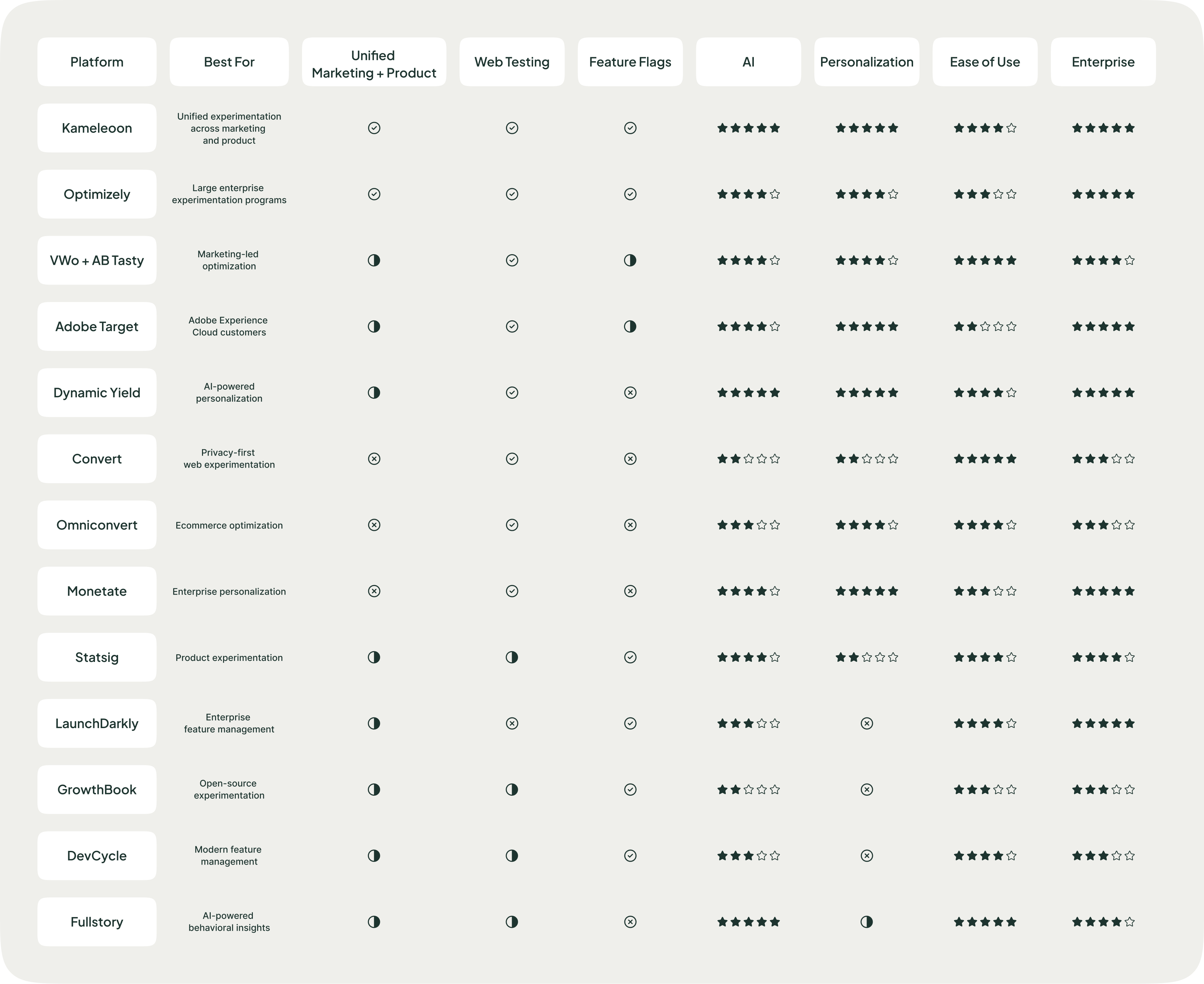
Experimentation platforms at a glance
With so many experimentation platforms available, narrowing down your shortlist can feel overwhelming.
The table below summarizes where each platform excels to help you identify which solutions best fit your organization’s needs.
Final thoughts
Experimentation platforms have evolved well beyond simple A/B testing.
Today's leading solutions support everything from web optimization and feature flagging to AI-assisted workflows, personalization, and product experimentation.
Rather than searching for the platform with the longest feature list, focus on finding the one that aligns with your team's workflow, technical expertise, experimentation maturity, and long-term goals.
The right platform should make experimentation easier to scale, encourage better decision-making, and help your organization learn faster from customer behavior.
Whether you're just launching your first A/B test or managing a mature experimentation program across marketing and product teams, investing the time to evaluate your options carefully will pay off for years to come.
{{cta-block}}
FAQs
The "best" experimentation platform depends on your organization's goals, technical resources, and experimentation maturity.
If you're still narrowing down your options, these recommendations provide a good starting point.
Most leading platforms now include AI-assisted workflows, including Kameleoon PBX, Optimizely Opal, VWO Copilot, AB Tasty AI, and Dynamic Yield.
Statsig, GrowthBook, LaunchDarkly, Kameleoon, and Eppo are particularly well suited to product experimentation and feature releases.
Rather than one direct replacement, organizations have adopted platforms like Kameleoon, Convert, VWO, AB Tasty, and Optimizely depending on their experimentation needs.
Kameleoon, Statsig, LaunchDarkly, GrowthBook, DevCycle, AB Tasty Flagship, and Optimizely all support feature experimentation in different ways.
It depends on your experimentation maturity and team structure.
Enterprise organizations often prioritize governance and personalization, while product-led companies may prefer warehouse-native experimentation and feature management.
.jpg)


Test your capability with this velocity calculator to learn how many experiments you could be running with your current traffic.
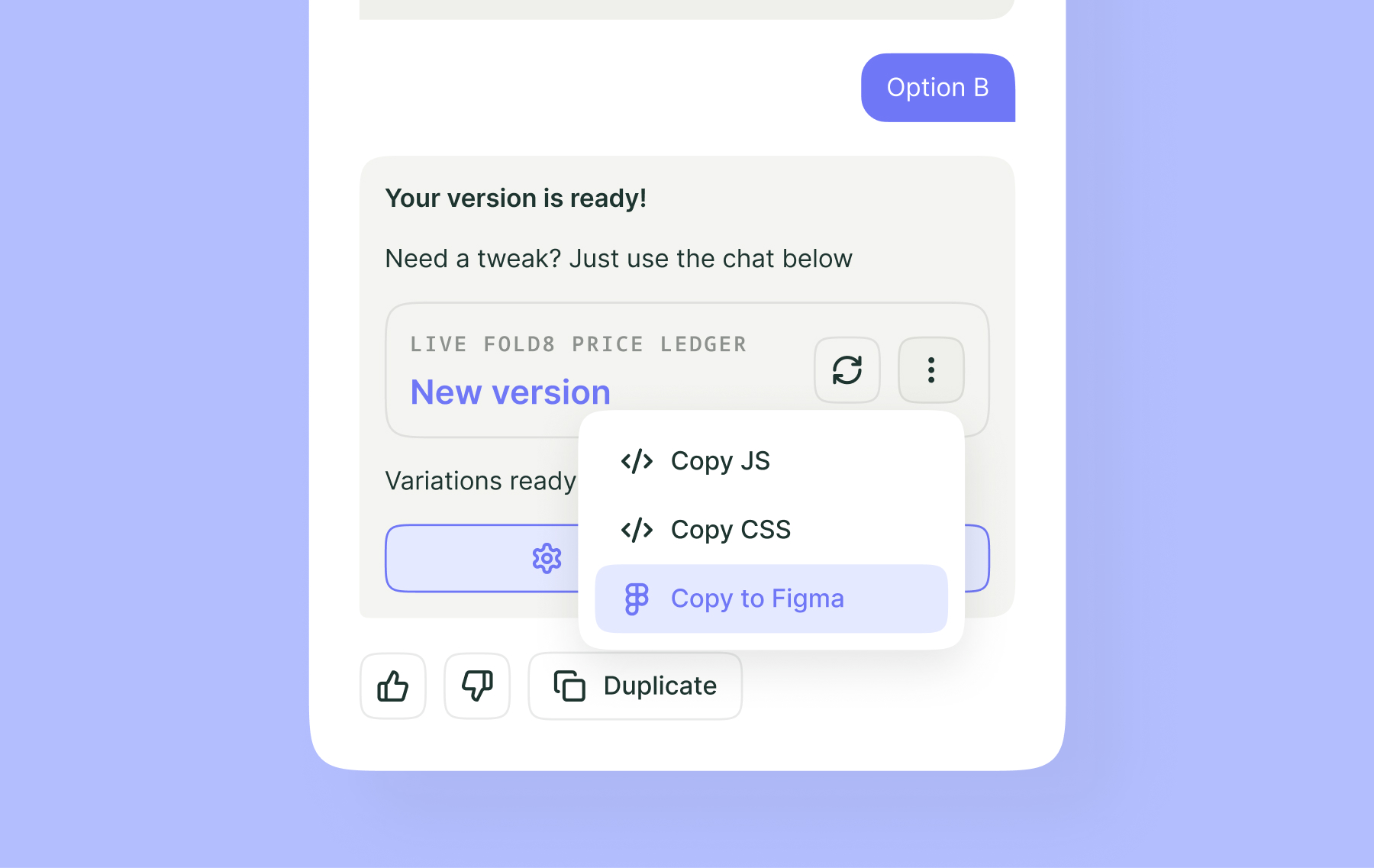
AI should help your team move faster. Kameleoon’s PBX now offers AI-native features that let your team build experiments in minutes through prompt-based tools and inputs.
To learn more about how to set-up and run experiments and AI-powered prompts through Kameleoon, click here to request a demo:
To learn more about how to set-up and run experiments and AI-powered prompts through Kameleoon, click here to request a demo: