How to enhance customer experiences in online banks using prompt-based experimentation


Banking and financial services teams almost never lack for test ideas, but execution is often another story.
Especially at major banks, developers are focused on building, maintaining, and securing core financial systems. Often, these are legacy systems that come with unique challenges and blockers that eat up much of their time.
The result is easy to imagine: experimentation velocity drops and the backlog grows. It’s hard to prioritize experimentation over securing financial systems and understandably so!
Kameleoon’s Prompt-based Experimentation (PBX) addresses this gap by allowing non-technical experimenting teams, like CROs, marketers, product managers, and designers, to tell an AI what tests they’d like to run in natural language and have on-brand variants built immediately, without mandatory developer input.
PBX: What the data shows
Alexandre Suon, the Head of Experimentation at Henkan & Partners, describes this shift as “specification-mediated automation;” “the shift from code-based implementation to intent-based implementation,” and the importance of expressing that intent clearly enough for the system to implement.
In his systematic evaluation of PBX, Suon found that PBX offers:
- Significant (~89%) time savings in experiment creation
- Over 90% prompt-to-variant accuracy for static page changes (text, layout, colors, etc.), and over 70% accuracy for more complex UX changes
- High code quality that holds up well in developer review
This means that PBX does not “do everything,” but can reliably clear your backlog and scaffold more complex ideas with proper QA.
Three practical PBX use cases for banking and finance
Here are three use cases pulled from common banking/financial services conversion and experience problems. Each one starts as a fast PBX build and can evolve into a more complex program once you see signals in the data.
1. Trust cues near sensitive actions
Security messaging can be hit-or-miss for banking teams; there is a fine line between reassuring a visitor and making them think about security concerns they hadn’t already had. PBX makes it easy to A/B test trust cues. Here, we use PBX to create a simple security test on the National Bank website:
2. Tooltips to reduce form abandonment
A well-placed tooltip can be a huge help in guiding visitors to complete forms that lead to in-person appointments, account openings, and more.
PBX can quickly add tooltips, FAQ blocks, and helper text, so you can find out what information users need to confidently submit forms.
In this example, we use PBX to build a relevant FAQ block beside a form on the CIBC site:
3. Contextual product suggestions during account opening
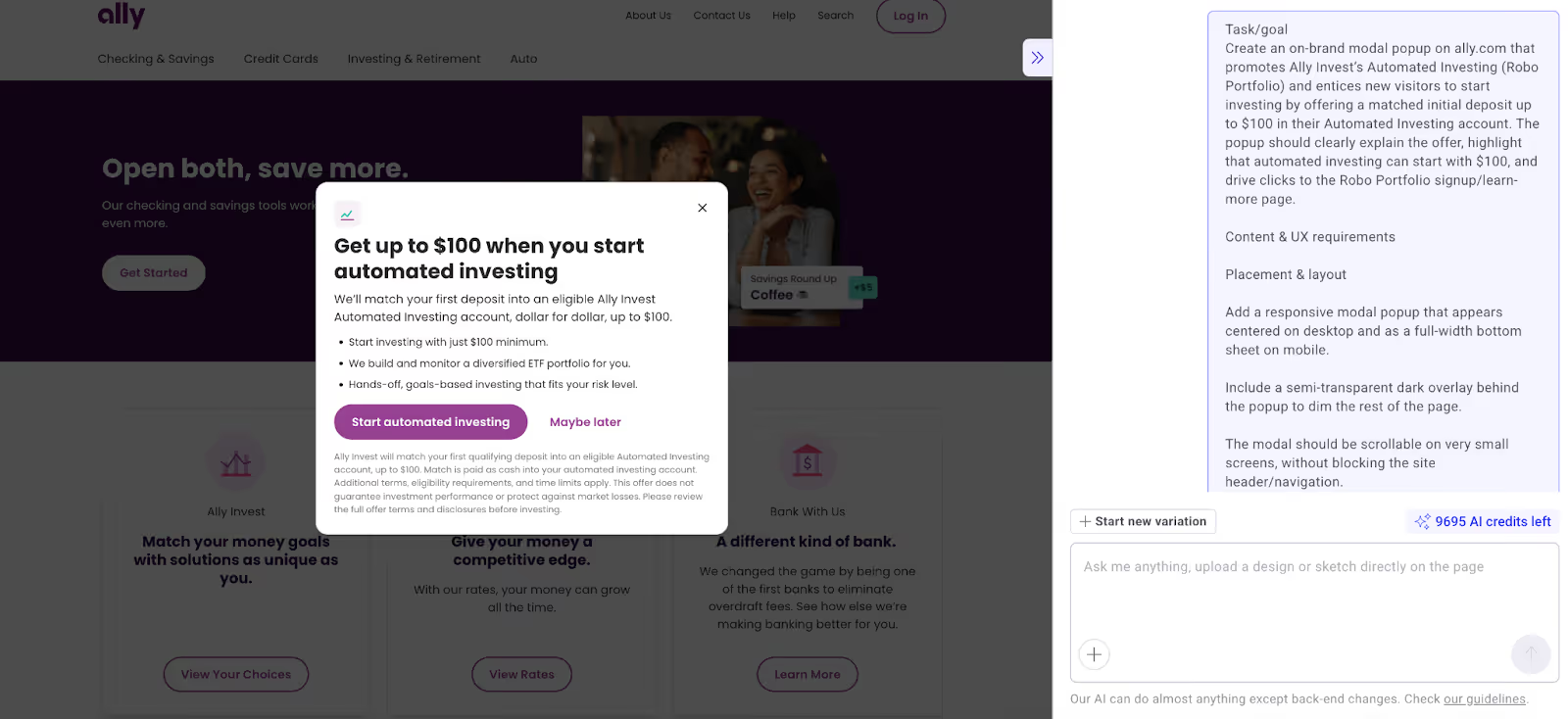
PBX can build popups and inline modules that help support cross-sell at the right time. For example, we use PBX to build a popup on the Ally website that offers contextual product suggestions and offers a timely discount for new investors:
Get the full banking PBX field guide
By adopting PBX, banking teams can finally keep up with their own ideas while keeping security and developer teams happy.
If you want the full playbook, our newest ebook, AI-Powered Experimentation: A Field Guide for Banking & Finance Teams breaks down more prompts and use cases to support fast, effective experimentation for BFSI teams.
.jpg)