What is multivariate testing (MVT)? Benefits & examples

What is multivariate testing (MVT)?
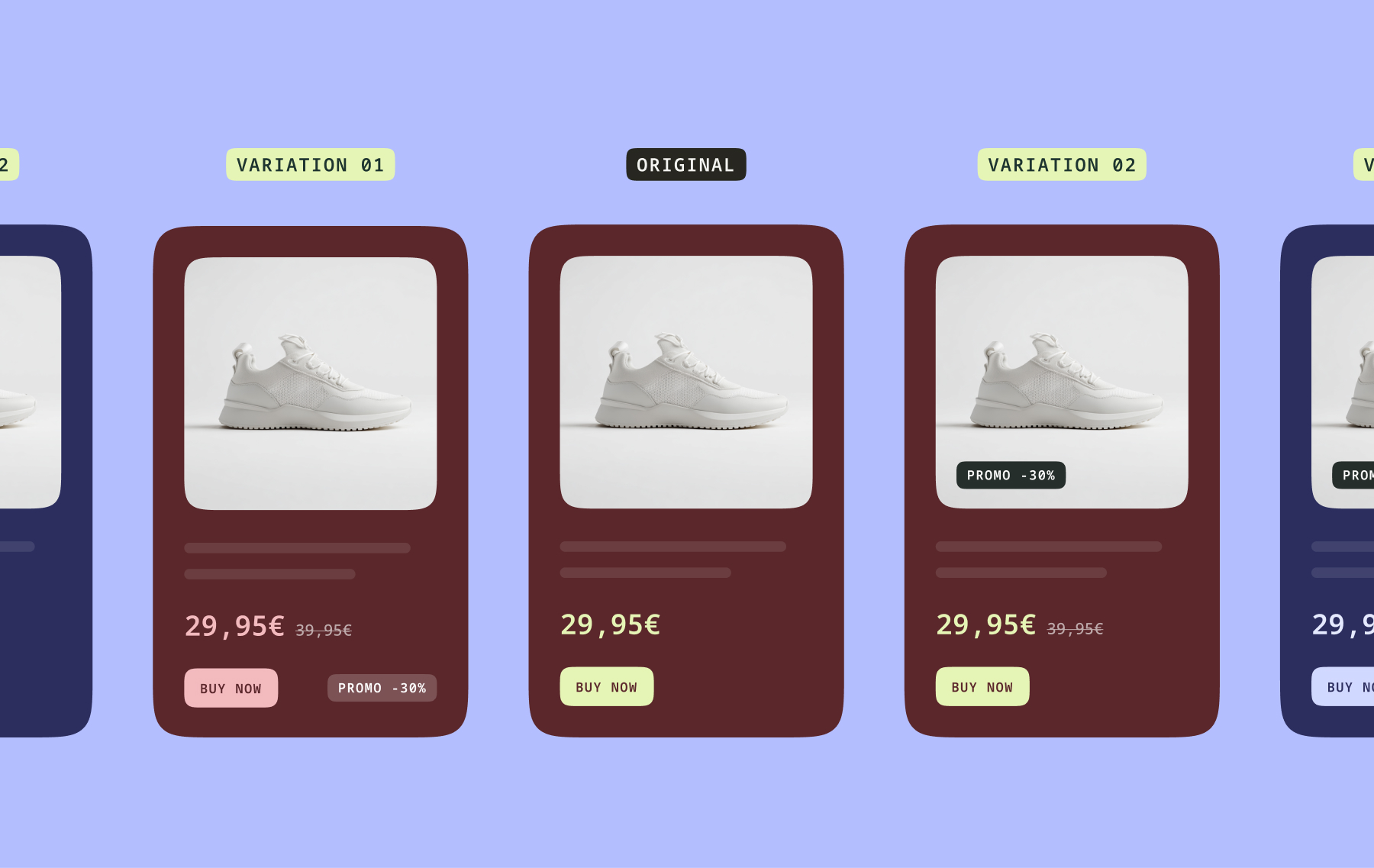
Multivariate testing (MVT) is an experimentation method that tests multiple elements of a webpage or digital experience at the same time to find the combination that performs best.
Unlike a simple A/B test, which typically compares one version against another, an MVT tests several variables and variations at once.
This approach helps you understand not only how individual changes affect performance, but also how those changes work together.
For example, a Call To Action (CTA) button color and image shape may each perform well on their own. But combine them, and the results can change.
That ability to uncover how different elements interact is one of the biggest advantages of multivariate testing.
How does multivariate testing work?
To understand the difference between an A/B test and an MVT, let's look at a simple example.
Imagine you want to optimize a CTA button and the image beside it.
With an A/B test, you might compare a green CTA button against a red one to see which performs better.
With an MVT, you could test the button color and image treatment at the same time.
For example, let's say you test:
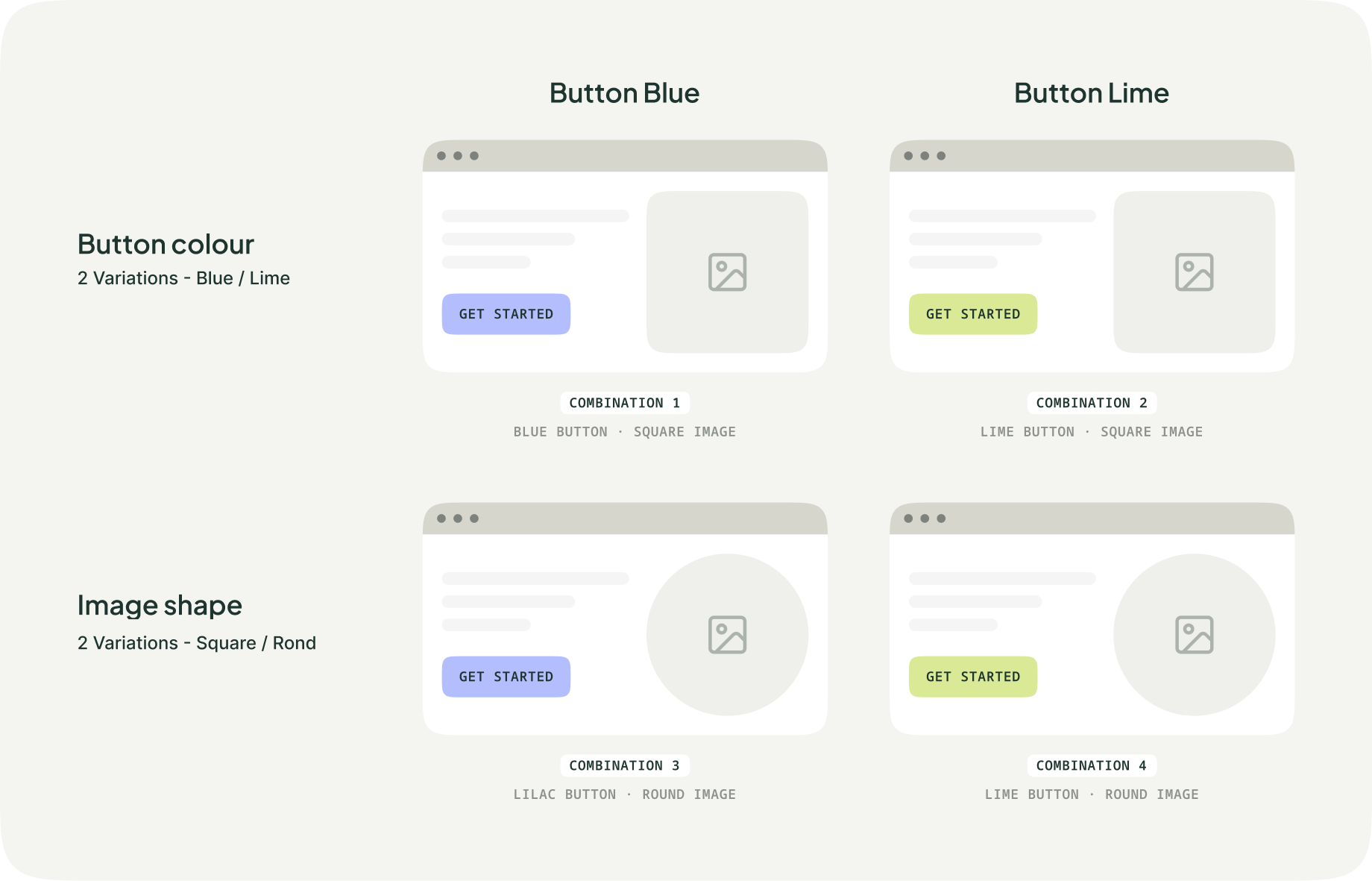
- Two button colors: green and red
- Two image shapes: square and circular
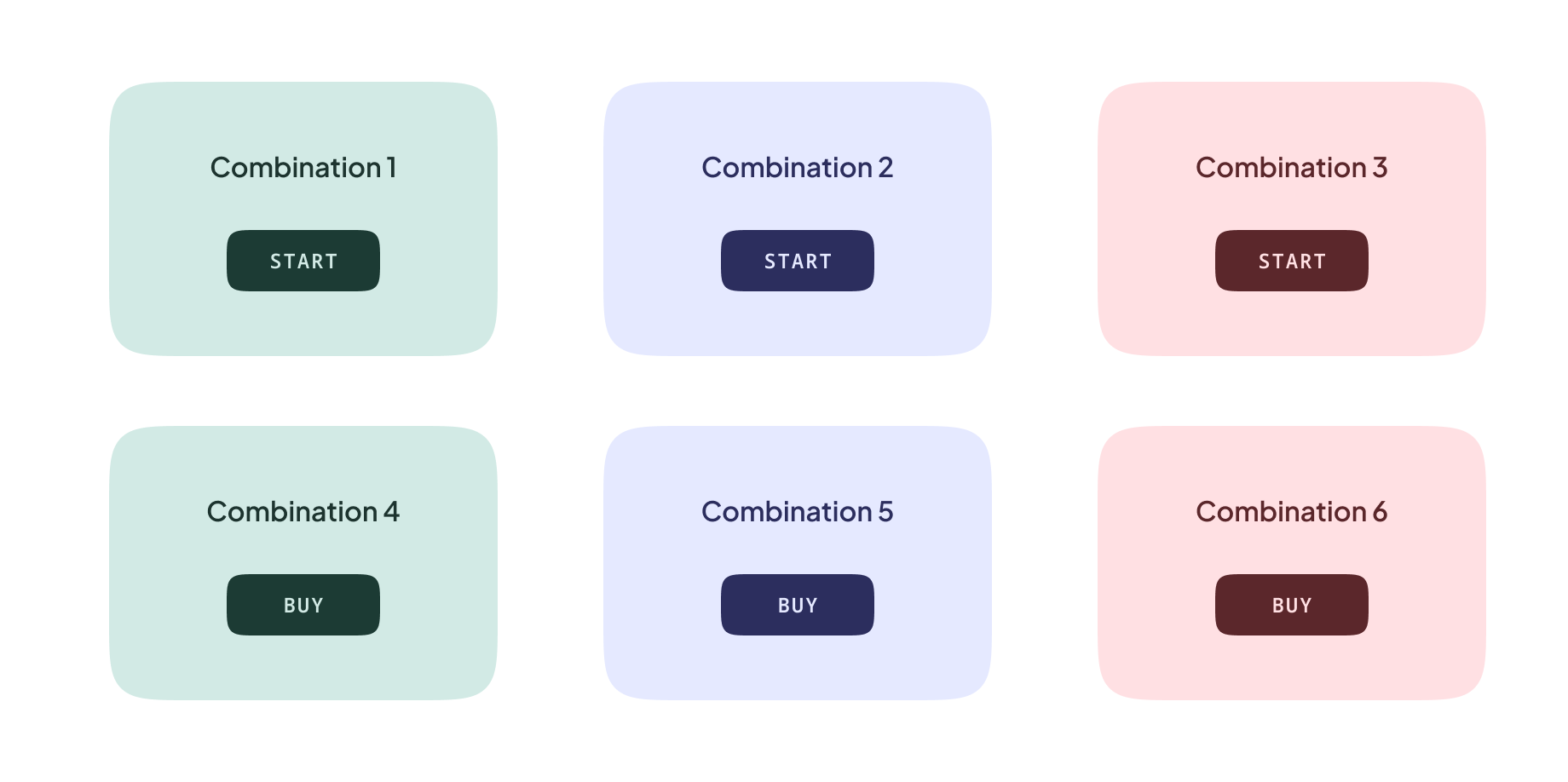
A full-factorial MVT would test every possible pairing, giving you four combinations:
Results are then measured by how the combinations perform against the selected success metric, such as conversion rate, signups, or revenue.
Benefits of multivariate testing
Multivariate testing takes more traffic and planning than a simple A/B test, but when used in the right situation, it can deliver much richer insights than a simple A/B test.
Here are some of the biggest benefits.
1. Learn more from a single experiment
One of the biggest advantages of multivariate testing is that you can learn more from a single experiment than a single A/B test.
Instead of running separate A/B tests to evaluate a CTA, image, or other page elements one after another, an MVT lets you test multiple variables and combinations at the same time.
Think back to our button color example.
Rather than running one A/B test to assess button color and another to evaluate image format, you could use an MVT to test both variables together.
This process gives you a much richer picture of what's actually influencing conversions because you can see not only which individual elements perform well, but also which combinations work best together.
That's something a traditional A/B test generally can't tell you.
A/B testing is great for comparing focused experiences or hypotheses, but it's not designed to isolate the effects and interactions of several variables changing at once.
With an MVT, you can look at the experience more holistically and identify the combination of elements most likely to drive conversions.
There's one important caveat: testing more at once doesn't necessarily mean you’ll get results faster.
Because traffic is divided across more combinations, an MVT typically requires more visitors and may need to run longer than a simple A/B test.
Therefore, the real advantage of an MVT isn't speed. Rather, it's getting more learning from a single experiment.
One well-designed MVT can answer a much richer set of questions than a single A/B test.
2. Uncover interaction effects
Another major advantage of multivariate testing is that it can reveal interaction effects.
An interaction effect happens when the impact of one change depends on another change. In other words, two elements might perform one way on their own, but behave very differently when you put them together.
For example, imagine a different button color increases conversions by 2% while a new image format increases conversions by 5%. If their effects were simply additive, you might expect combining them to produce a 7% lift.
But what if the combination increases conversions by 10%?
That extra 3% lift suggests a positive interaction effect.
It reveals that pairing the new button color with the updated image format makes the combination work better than either change would on its own.
Interaction effects can work in the opposite direction, too. Two variations that perform well individually might actually perform poorly when combined.
As such, rather than looking at each element in isolation, an MVT can show you how elements work together and uncover winning, or losing, combinations that a series of separate A/B tests might miss.
And because you're testing combinations, you may discover a winning experience that you wouldn't have found by evaluating each change individually.

3. Increase your chances of uncovering a winner
Another benefit of multivariate testing is that exploring multiple ideas at once gives you more opportunities to uncover something that works.
This fact is a major advantage because experimentation research consistently shows that most ideas don't perform as well as teams expect.
In fact, according to research from Microsoft’s large-scale experimentation program, only about one-third (33%) of tested ideas successfully improved the metric they were designed to improve.
Put another way, if you test just one idea, the odds aren't necessarily in your favor.
But what happens when you explore more ideas?
Using Microsoft's 33% success rate as a simple illustration, if five ideas each independently had a 33% chance of succeeding, the probability of finding at least one winner would rise to about 87%. That's roughly 2.6 times the chance of encountering a winner compared with testing just one idea.
Of course, variables within a real MVT aren't necessarily independent, so the 87% figure is simply an illustration of the value of exploring more ideas, not a predicted MVT success rate.
This idea is captured nicely by Jeff Bezos' observation that “big winners pay for so many experiments.” Most ideas won't produce dramatic results. But finding the few that do can make all that experimentation worthwhile.
The more well-founded ideas you explore, the more opportunities you have to discover the relatively rare ones that produce meaningful gains.
Drawbacks of multivariate testing
However, MVTs aren’t without their limitations. Some of the main drawbacks of MVTs include:
Require more traffic
One of the biggest limitations of multivariate testing is that the approach typically requires much more traffic than a simple A/B test.
That's because your visitors aren't being divided between just two experiences. They're being distributed across all the different combinations in your experiment.
And these combinations can add up quickly.
For example, if you test three variables, let’s say button color, button copy, and image format, with two variations each, A and B, you already have eight possible combinations.
Add another variable with two variations, and you're up to 16.
Here’s a simple diagram illustrating this concept:
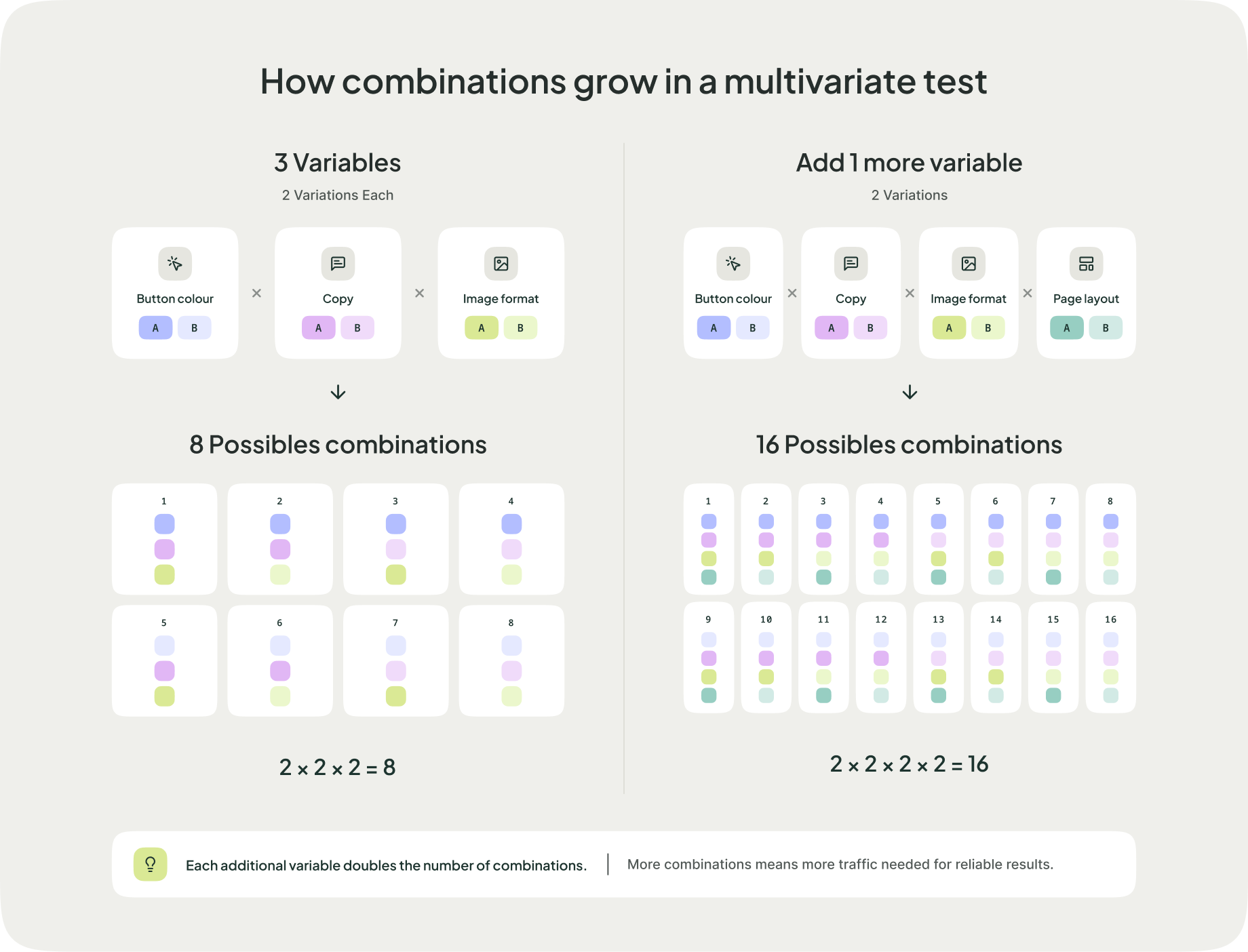
Each of those combinations needs enough visitors to produce reliable results.
Which means, if you spread your traffic too thinly, your experiment may be underpowered and unable to detect meaningful differences between experiences. In other words, you may end up with results you can't trust. And if you can't trust the results, why run the test at all?
That's why MVTs are not good options for lower-traffic websites.
As a rough screening benchmark, MVT is generally best suited to high-traffic experiences, often those receiving 100,000+ visitors per month. But there is no universal traffic cutoff. What really matters is whether you have enough traffic to adequately power every combination in your experiment
Therefore, before launching an MVT, it’s important you estimate the sample size you'll need based on your baseline conversion rate, the size of the effect you want to detect, and your desired statistical power. Then make sure you have enough traffic to adequately support all the combinations you plan to test.
If the numbers don't work, simplify the design or stick with A/B testing until you have enough traffic to support a more complex experiment.
Alternatively, if traffic is a concern, you can also consider setting up a partial-factorial MVT.
In a typical MVT, known as a full-factorial MVT, every possible combination of the selected variations is tested. This approach provides the most complete view of how the variables and combinations perform, but, as discussed, it also requires more traffic.
In contrast, a partial-factorial MVT tests only a subset of the possible combinations.
This set-up can reduce traffic requirements and avoid combinations that do not make practical sense, although the tradeoff is that you collect less complete information about the full set of interactions.
Take longer to run
Multivariate tests can also take more time and effort to run than simple A/B tests.
For starters, there’s more work to do before the experiment even launches.
Testing multiple variables and combinations may require additional copy, designs, development, implementation, and QA to make sure every experience works as intended.
Then there’s the test itself.
Because traffic is divided across multiple combinations, each element that’s measured needs enough visitors to produce reliable results.
Depending on your traffic and the complexity of your test, reaching a useful conclusion can take longer than it would with a simple A/B test.
Can be more complex to interpret
And even once the experiment is over, you’re still not out of the woods because you now have an enormous analysis task ahead of you.
That’s because instead of simply determining whether A or B performed better, you need to understand the impact of individual variables, different combinations, and any interaction effects between them.
And as you add more variables and combinations, the analysis becomes increasingly complex.
There’s also a greater risk of finding an apparent “winner” simply by chance.
This outcome is known as the multiple comparisons problem.
The more combinations and outcomes you compare, the more opportunities there are for random fluctuations in the data to look like meaningful results, increasing your risk of a false positive.
Now, this fact doesn't mean you shouldn't run complex MVTs. Instead, it means your statistical approach needs to account for the design and complexity of the experiment so you can separate genuine effects from random noise.
When should you use an A/B test vs MVT?
If, at this point, you’re left scratching your head, wondering whether running an MVT is the right route for you, here are some simple guidelines to follow:
A/B testing use cases
A/B tests are usually the better choice when:
- You want to validate one focused hypothesis
- Your website or experience does not have enough traffic to adequately power an MVT
- You are testing a major redesign or concept where the experience should be evaluated as a whole
- You need a simpler or faster-to-interpret experiment
- The variables are unlikely to interact meaningfully
MVT use cases
MVTs are most useful when you have enough traffic, a clear optimization objective, and a reason to believe multiple elements of an experience may influence one another.
Good candidates for MVT often include:
- High-traffic landing pages
- Pricing and plan-selection pages
- Product pages
- Signup and lead-generation flows
- Checkout experiences
- High-volume campaign pages
MVTs are especially useful when:
- You’re optimizing an established experience with reliable baseline data
- Several page elements are plausible drivers of the same conversion goal
- You care about finding the best combination, not just the best individual element
- The variables are sufficiently related that interaction effects are plausible
- You have enough traffic to support the number of combinations you want to test
- Your team has the design, development, QA, and analysis resources to execute the experiment properly
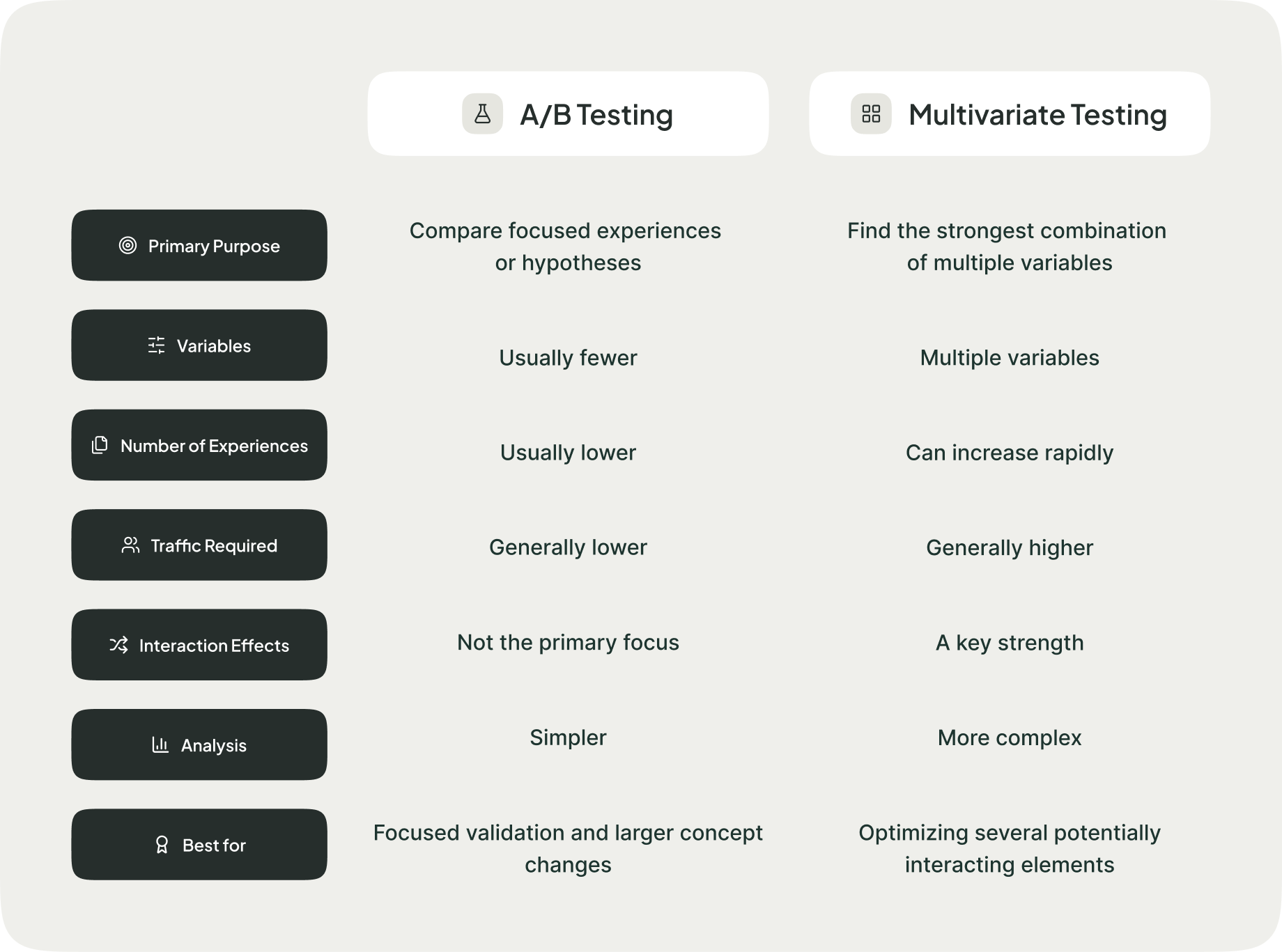
Here’s a diagram that illustrates the optimal use cases for A/B testing versus MVTs:
Common multivariate testing mistakes
If you do decide MVTs are the right approach for you, be careful to not fall into these testing traps:
Don’t test too many variables
It is tempting to use MVT to test everything at once. But every additional variable can dramatically increase the number of combinations and dilute the traffic reaching each one.
Don’t test too many variables at once!
Instead, focus on a small number of elements that have a strong behavioral rationale and are likely to influence the same outcome.
If you can’t explain why the variables are key to the test, they probably shouldn’t be in the same MVT.
Don't stop the experiment early
No matter what kind of experiment you're running, resist the temptation to call a winner too soon.
Early in a test, results can fluctuate quite a bit. A combination that looks like a clear winner in the first few days may lose its lead, or even become the loser, as more data comes in.
The danger comes when you repeatedly check an experiment and make decisions based on those interim results.
This practice is often referred to as “peeking.”
If you’re using a statistical approach that isn't designed for continuous monitoring, peeking and stopping as soon as you see a favorable result can increase your risk of reaching the wrong conclusion.
That's why it's important to define your decision criteria and required sample size before launching the experiment, then stick to them.
Let the MVT run long enough
You should always calculate your experiment run time ahead of time based on factors such as your traffic, baseline conversion rate, minimum detectable effect, metric variability, number of combinations, and statistical methodology.
As a practical rule of thumb, many web experiments run for around two to six weeks.
Running for at least two weeks can help capture differences between weekday and weekend behavior and cover multiple business cycles. Stopping at six weeks limits any discrepancies with your data.
But don't use the calendar alone to decide when to stop.
Your experiment still needs to reach its required sample size and meet the decision criteria you established before launch.
If an MVT needs to run substantially longer than six weeks to collect enough traffic, take another look at the design.
It may be a sign that you're testing too many combinations for the traffic you have. Longer-running experiments also deserve extra scrutiny because seasonality, campaigns, traffic composition, and customer behavior can change over time.
As well, whenever possible, the experiment should also capture complete business cycles. If behavior differs significantly over a specific timeframe like the summer or winter holiday season, you'll want your test to account for those patterns rather than drawing conclusions from an unrepresentative slice of traffic.
Don’t ignore guardrail metrics
When running an MVT, it’s important that you look all the way down the funnel and not optimize only for a single conversion metric in isolation.
For example, a combination that improves CTA clicks but reduces completed purchases, increases errors, or harms another important business metric may not be a true winner.
Define primary, secondary, and guardrail metrics before the test begins.
The bottom line
Multivariate testing can uncover insights that are difficult to get from a simple A/B test, but more variables don't automatically mean better experiments.
The strongest MVTs are focused, properly powered, run for an appropriate amount of time, and measured against the metrics that actually matter to the business.
In other words, the goal isn't to test everything you can. It's to test the right things together and learn something useful from the results.
And increasingly, AI is helping experimentation teams do exactly that.
How AI is changing multivariate testing
AI is making multivariate testing more efficient, especially when it comes to deciding what is actually worth testing.
As you've learned, one of the challenges with MVT is that the number of possible combinations can grow quickly. You don't want to test every headline, image, CTA, layout, and design treatment simply because you can.
But here's where AI can help.
AI tools can analyze behavioral data, previous experiment results, analytics, heatmaps, session recordings, and other customer data to identify potentially high-impact variables before an experiment begins.
Experimentation teams can also use AI to:
- Generate and refine copy, messaging, and design variations
- Prioritize variables and combinations so an MVT doesn't become unnecessarily large
- Identify patterns across previous experiments that could inspire new hypotheses
- Suggest potential interactions between variables worth investigating
- Accelerate analysis and surface segments or patterns that deserve a closer look
In this way, AI can help teams move from “What could we test?” to “What is most worth testing?”
From AI-assisted testing to prompt-based experimentation
We're also starting to see AI become much more deeply integrated into the experimentation process.
One example is Kameleoon's Prompt-Based Experimentation (PBX), which allows experimenters to use natural-language prompts to help ideate, build, configure, analyze, and launch experiments.
Kameleoon's PBX Ideate can scan a webpage and generate test ideas and hypotheses based on its experimentation framework.
Once an idea is selected, PBX can generate the test variation, while other AI agents can help configure elements such as targeting, traffic allocation, and goals.
After the experiment runs, PBX Analyze can help capture and interpret the results.
This type of workflow can be particularly useful for multivariate testing because AI can help reduce some of the work that traditionally makes MVT cumbersome.
Instead of manually creating every variation, configuring a complex experiment, and then digging through all the resulting data, AI can assist across multiple stages of the process.
Ultimately, AI tools may make sophisticated experimentation much more accessible, while allowing experimenters to spend more of their time thinking about what they want to learn.
But AI still doesn't replace experimentation. At least not yet.
An AI-generated recommendation, predicted winner, or interesting pattern is still a hypothesis.
And while AI might tell you that a particular headline and CTA combination looks promising based on previous data, it doesn't mean that combination is guaranteed to increase conversions.
That's still what experimentation is for.
The most powerful approach may be to use AI to make experimentation smarter and more efficient, and experimentation to validate whether AI's recommendations actually work.
How to run a multivariate test with Kameleoon
No matter how deep you’re digging into AI, Kameleoon supports multivariate testing as part of its broader experimentation platform, giving teams the tools to build, target, launch, and analyze experiments without relying on extensive engineering resources.
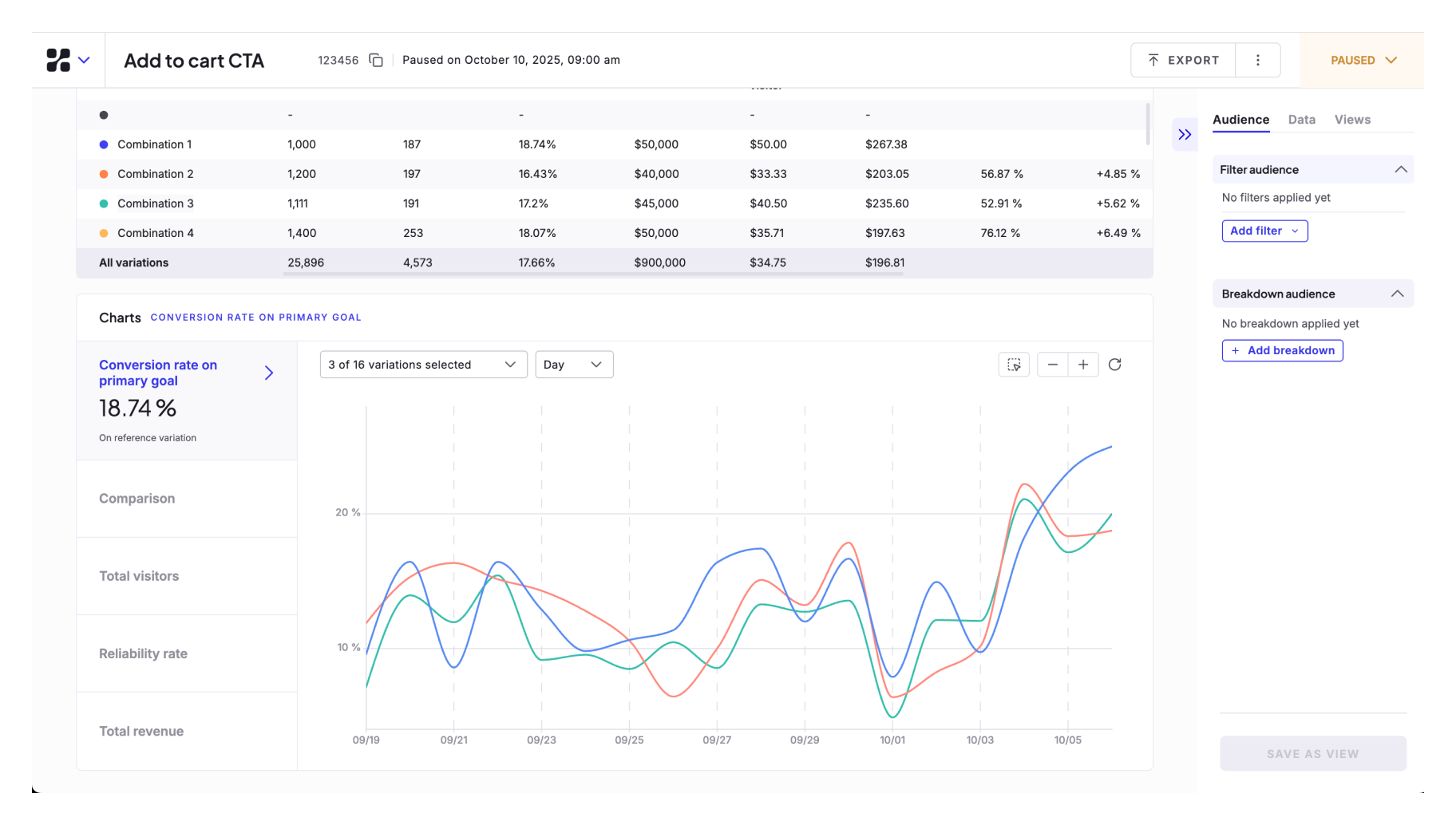
Here's what the process of setting up an MVT on Kameleoon looks like.
- Define your hypothesis and success metric: start with the problem you're trying to solve and the business outcome you want to influence. For example, you might hypothesize that changing both the CTA button color and image shape on a landing page will increase signups. Before building the experiment, define your primary success metric and any guardrail metrics you'll use to evaluate the results.
- Choose the variables you want to test: identify a small number of related elements that you believe could influence the outcome. For example, you might test two CTA colors and two image shapes (square and circular). Remember, combinations add up quickly. Those two variables with two variations each would already create four possible new experiences, which means you would have to test six total variations (the original of each plus the four combinations).
- Create your variations: Build the different treatments you want to test. Kameleoon supports multivariate testing within its Graphic Editor. Your team can make visual changes to elements such as copy, images, colors, and page components, while more technical teams can use code-based approaches for more complex experiments. Kameleoon's AI-powered Prompt-Based Experimentation (PBX) can further streamline this process by helping teams identify test ideas and generate test-ready variations using natural-language prompts.
- Check your combinations and traffic requirements: Before launching, calculate how many combinations your MVT will create and make sure you have enough traffic to adequately support them. Remember: the goal isn't to squeeze as many variables as possible into a single experiment. It's to test enough combinations to answer your research question without spreading your traffic too thinly. If the required sample size is unrealistic, simplify the experiment.
- Target and launch your experiment: Once your variations are ready, determine who should enter the experiment and how traffic should be allocated. Kameleoon provides audience targeting and traffic-allocation capabilities so teams can control which visitors enter an experiment and how they're assigned to different experiences. Before going live, QA every combination to make sure the variations display correctly and your goals and tracking are working as expected.
- Monitor experiment quality: Once your MVT is running, keep an eye on its health without prematurely calling a winner. Kameleoon provides real-time experimentation data and automatically detects issues such as Sample Ratio Mismatch (SRM), which can indicate that visitors aren't being allocated across experiences as expected. Continue running the experiment according to the sample size and stopping criteria you established before launch.
- Analyze what you learned: Once the experiment is complete, don't look only at which combination won. Dig deeper to understand what the experiment tells you about the individual elements and how different experiences performed. Kameleoon provides reporting and breakdown capabilities for analyzing experiment results. KAI, Kameleoon’s AI assistant, can also summarize results and surface insights and recommended next steps. The goal is to come away with more than a winning page. You want to understand what that teaches you about your customers.
- Turn your findings into your next hypothesis: Finally, use what you've learned to guide your next experiment to continually optimize upon your success. A winning MVT shouldn't be the end of the learning process. Its results can reveal new questions, interaction hypotheses, audience differences, and optimization opportunities worth exploring.
- Book a free demo: Kameleoon brings web and feature experimentation together within a unified platform, allowing marketing, product, and development teams to continue testing and applying those learnings across the customer experience. Ready to see how MVTs work in practice? Book a free Kameleoon demo to learn how your team can build and analyze multivariate experiments at scale.
Start testing combinations that matter
Multivariate testing is most powerful when it is used for the right question.
It’s not simply a way to pack more variations into one experiment. The real value is the ability to understand how multiple elements contribute to performance and how those elements interact as part of a complete customer experience.
For high-traffic teams with mature experimentation programs, MVT can provide richer insight into which combinations of content, design, and messaging drive meaningful business outcomes.
{{cta-block}}
FAQs
A multivariate test allows you to test several individual elements at the same time, while an A/B/n test tests multiple variations. If you don't have enough traffic to run a full multivariate test, an A/B/n test is a reasonable alternative that can tell you which overall variation is a winner, but not which specific element change drove the results.
A/B testing is usually better when traffic is limited, you are validating a focused hypothesis, you are testing a major concept or redesign as a complete experience, or you do not need to measure interactions among several variables.
An interaction effect occurs when the combined impact of two or more variables differs from what you would expect based on their individual effects. The interaction can be positive or negative.
Multiply the number of variations for each variable. For example, 3 headlines × 2 images × 2 CTA treatments creates 12 possible combinations in a full-factorial design.
A full-factorial MVT tests every possible combination of the variations you've selected. For example, if you're testing two button colors and two image formats, a full-factorial test would evaluate all four possible combinations. This approach gives you the most complete picture of how the variables perform individually and together, but it also requires more traffic.
A partial-factorial MVT tests only a carefully selected subset of the possible combinations. This approach reduces the traffic and time required, but the tradeoff is that you collect less complete information about all possible effects and interactions.
Use as few as necessary to answer the hypothesis. Every additional variable can multiply the number of combinations, so prioritize elements with a strong rationale and plausible interaction.
As a practical benchmark, many web experiments run for around 2–6 weeks, but there is no universal MVT runtime. Your test should run long enough to reach its required sample size and capture representative business cycles. If an MVT will take substantially longer than this timeframe because traffic is spread across too many combinations, consider simplifying the design.
There is no universal visitor threshold. Required traffic depends on your baseline conversion rate, minimum detectable effect, statistical power or methodology, metric variability, and the number of combinations. The more combinations you create, the more traffic you need.
No. Both are controlled experimentation methods, but an MVT deliberately evaluates multiple variables and combinations within the same experiment. A/B testing is generally simpler and is often used for a more focused hypothesis or comparison.
.jpg)



Ready to explore multivariate testing? Book a Kameleoon demo to see how your team can build and analyze multivariate experiments at scale.
Ready to explore multivariate testing? Book a Kameleoon demo to see how your team can build and analyze multivariate experiments at scale.