Vegas and vanilla: the role of human creativity in AI designs

There’s an idea floating around product, marketing, and design teams using AI right now: given model behavior is based on best practices, and everyone prompts from the same handful of models, how long before everyone’s website has the same homepage?
Many experimenters will say that this is unlikely, or that “best practices” are far from universal and don’t necessarily apply across disciplines.
Behavioral scientist Kristen Berman, CEO of Irrational Labs, has another perspective, one that celebrates human creativity as mandatory, with no real limit on its potential.
AI defaults make sameness easier
Left alone, most AI design recommendations trend towards familiar patterns. LLMs generate familiar layouts, copy, and concepts that might remind you of what was trendy a few years ago.
As a result, and as Berman notes, an AI model’s default recommendation for a new design is still worse than what a designer would create from the same instructions.
The fear comes from the fact that AI models are constantly improving, re-training, and updating with new information. It’s easy to imagine a world, not so many years from now, in which LLMs can efficiently and quickly outpace designers and the cost of producing a “good enough” website collapses into one single prompt.
Then, when everyone has access to that same prompt, how does anyone even begin to stand out?
Creativity matters in a noise market
The answer, in Berman’s own words, is a familiar one with a unique frame:
{{quote}}
This perspective paints something of an ironic picture: as AI models strengthen, human creativity grows in importance. This is a market mechanic: the more “good enough” options a buyer has, the harder it is to win their attention.
Put another way, Vegas is not loud because there is a uniquely creative marketing core there; it is loud because everyone in Vegas is competing for the same people against the same people, and with no rule against being louder than their neighbor.
As the cost of building drops, more builders enter the market. As more builders enter the market, sameness becomes easier, faster, and more common. So the teams that use AI with designers to produce bold variants, weird hypotheses, and new ideas are the ones that will continue to stand out in saturated markets.
Best practices are still best practices
Of course, none of this is to suggest that best practices are always bad or will become bad. There will always be many cases where best practices are the right starting point because of experiments that have already been run, at scale, by someone with enough sample size for reasonable conclusions. The science still builds upon itself.
{{quote1}}
An easy example is e-commerce nav bars. Amazon, Booking.com, and Wayfair all run experimentation programs at scale, so reinventing their nav bars is probably not a good use of resources. Berman’s advice is to look at best practices as baselines, not ceilings.
What this means for experimentation programs in 2026
There are three things experimentation programs should keep in mind when thinking about Berman’s Vegas framing:
- Companies that test with AI assistance run more experiments per quarter than they did two years ago. Berman’s framing makes it clear, however, that the teams that test the most differentiated ideas (rather than just the most ideas) are the ones most likely to pull ahead of the competition.
- “Let’s create our hypothesis from the point of insight,” Berman says. She’s speaking of behavioral science, but the principle applies to experimentation too. Building on your own historical wins, meta analyses, and ideation makes it much easier to create the bold, weird, and creative ideas that define your brand well.
- AI is the accelerator on the bold idea. It is not a substitute for the bold idea. Teams that use prompt-based experimentation are building variants in minutes, but they’re also testing points of view. The driver is still a human with taste, context, and conviction. The AI makes it easier (and much cheaper) for them to be wrong, which is what enables the boldness.
{{blue-block-1}}
Be the brightest sign on the strip
AI can only make every site look the same if every team uses AI the same way. For teams that embrace experimentation-led growth, this isn’t a bad thing; if anything, it makes it easier for them to stand out. Those are the teams who will own the noisy decade ahead, the ones who shun being vanilla and embrace Vegas instead.
{{cta-block}}
.jpg)
“If you have more builders making more things, the world is going to be incredibly noisy, and people are going to need to stand out. With a noisy world, people do a lot of things to stand out. I like to compare it to Vegas. Vegas has no zoning regulations on signs. And so signs are crazy in Vegas, because you just want to be bigger and better than the person next to you. … The idea is that human creativity could actually get higher because we need to be the best flyer on the flyer pole for people to read us.”

“Generally, if you know that a company is experimenting and they’re in your domain, it is likely you can get some hypothesis from looking at what they’ve done. We would not take a random startup and get ideas from them because they’ve not done experiments—they don’t have enough sample size. Larger companies do.”

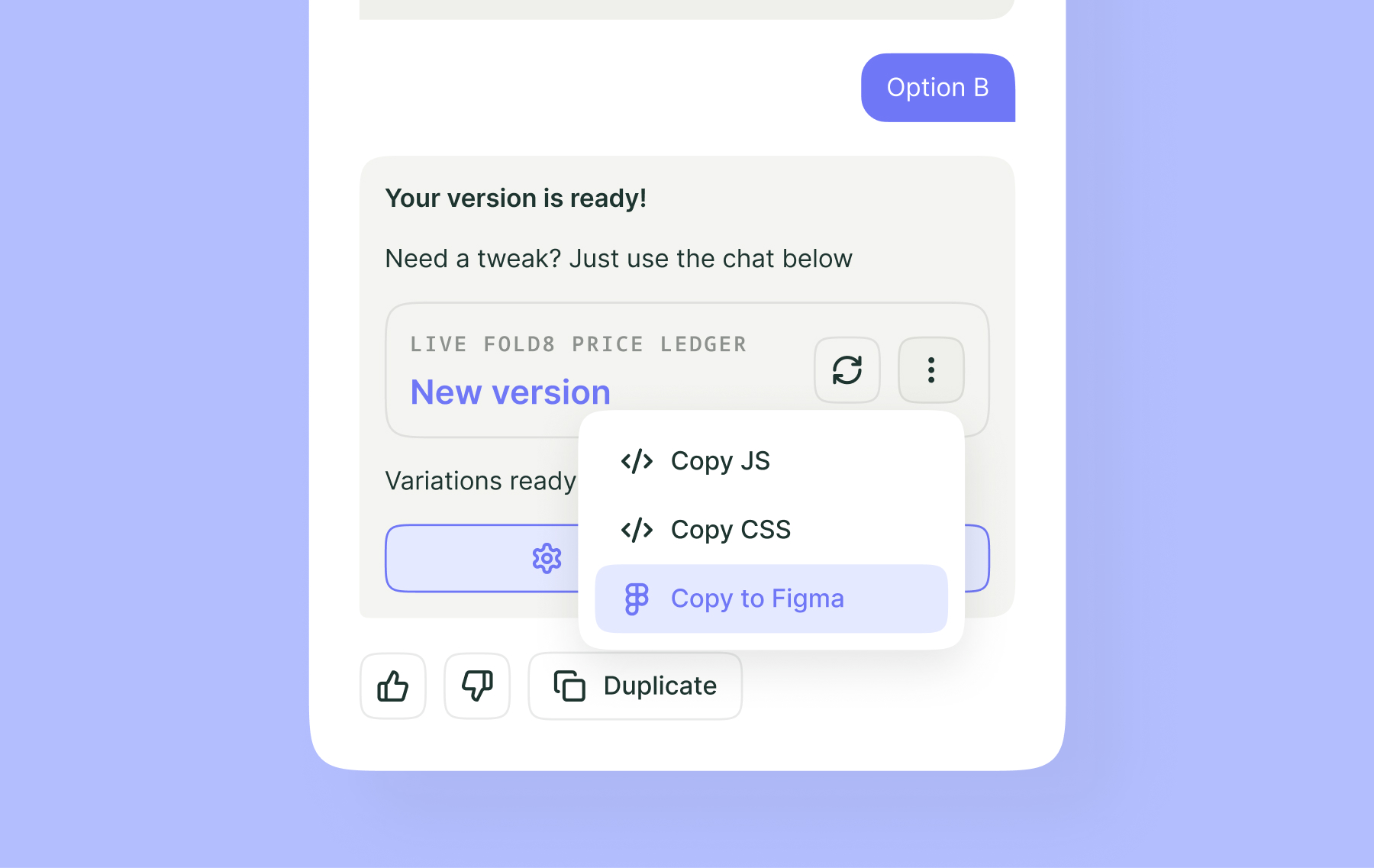
Want to try prompt-based experimentation for yourself? Start your free trial of Kameleoon’s PBX here.
Want to hear more? Kristen Berman discusses human vs. AI creativity, behavioral science in experimentation, and what influences user decisions on Unite Voices, Kameleoon’s podcast featuring real stories from the people behind today’s most innovative experimentation programs.
Want to hear more? Kristen Berman discusses human vs. AI creativity, behavioral science in experimentation, and what influences user decisions on Unite Voices, Kameleoon’s podcast featuring real stories from the people behind today’s most innovative experimentation programs.