Do you need experimentation tools when AI can write code?

In 2026, A/B testing practitioners are still debating: can experimentation be a practice for non-technical people? Large language models make it increasingly easy for experimentation to be a discipline for all, as both general-purpose LLM coders and dedicated experimentation tools incorporate ways for non-technical teams to build tests.
But there’s more to experimentation than simply building tests, and most of it happens on your own website: adding the variations to your site, configuring audience settings, tracking results, learning, and shipping winners.
So the answer depends on which solution you’re using: general-purpose LLMs, like Claude, Codex, or Lovable, to build variations offsite and port them over (which would require developer input) or AI-powered experimentation platforms like Kameleoon’s PBX or VWO’s Copilot (which can reduce developer input to quality assurance checks).
Of course, reality is much more nuanced than two simple categories. AI coding tools like Claude and experimentation platforms like PBX can be symbiotic, especially when the experimentation tool provides a robust MCP.
This article will cover where the two approaches are different and where they should be combined, and explore three main differences:
- Experimentation tools are designed specifically for experimentation.
- Vibe code tools integrate differently into codebases than experimentation tools.
- Each tool type supports the human in the loop differently.
Experimentation tools are designed for experimentation
It sounds obvious, but this is one of the most nuanced and interesting differences between specific A/B testing software and general-purpose LLMs. Experimentation does not end with building variations; LLMs can write variation code, but they can’t randomize experiences, track user behavior, dynamically allocate traffic, or apply proper statistical methods to tests and they aren’t nearly as friendly to non-developer teams. This makes them less adept at experimentation as a complete process even though they can build variations based on your input.
To illustrate this, we’ll look at three examples: building web experiments (tests that can be deployed without touching the codebase) with LLMs, building feature experiments (tests requiring a code deployment) with LLMs, and using AI-powered/prompt-based experimentation tools.
Building web experiments with LLMs
If you’re not part of a technical team or don’t have easy access to experimentation tools, LLMs with coding capabilities, like Codex or Lovable, might look appealing. If they can code, they can build strong variations based on your existing website that your engineering team can use to set up and run A/B tests.
The main drawback is in context: general-purpose LLMs don’t know your website as intimately as you do and can’t generate a perfect variation. That means you as the prompter need to provide significant context and babysit the result until it resembles your goal. General-purpose LLMs are, after all, general-purpose; they do not come with tools that are designed to generate experiment variations, which means a developer needs to teach it using context from your specific website.
This approach can quickly burn time and tokens. If you aren’t a developer or are new to experimentation, you may find this approach works better for basic web experiments to limit those sinks.
Conversely, a well-setup experimentation platform is easy to set up, requiring no custom skills or MCP workflows.
Setting up your experiment-building skill in Claude, for example, will take hours to get to the same point PBX starts at. You will need to tell it:
- What your requirements are
- Important page context, including screenshots of the page(s)
- This is not necessary if the LLM has a browser extension that can scan your page
- Selectors and reusable components
Then, once it has generated your variant:
- Deploy the code
- Preview, debug, and iterate
- Validate response behavior
- Set up experiment configuration and tracking
In all, setting up your LLM to truly understand your website is an ongoing process, with the initial setup taking anywhere from several hours to a couple of days.
That’s an impressive timeline. But if you use an experimentation tool like PBX, you skip both the contextual and setup steps, and can run the full process in only twenty minutes. That is why context is so important, and that is why platforms designed specifically for experimentation are, in the long run, much better for experimentation.
{{blue-block-1}}
Building feature experiments with LLMs
If you are part of a technical team with an interest in running A/B tests, you may get past the time/token hurdle by providing the LLM with your code directly and using it to build features and tests faster than you could coding by hand.
Some even include browser extensions that allow them to better understand your public-facing site in the same way as experimentation tools can.
What you still have to do by hand, however, is configuring, launching, and monitoring the test, especially when it comes to modifying features which demand cautious, non-disruptive coding to test. Ensuring that everything works properly, then setting up the experiment itself, costs a lot of the time saved by using the LLM.
There is also risk in allowing third-party tools to access your IDE, which is why this is only a viable option if you work in development or engineering teams that can monitor and fix any bugs in LLM code.
This also means you rely fully on engineering to build your tests using this approach. Granted, they’re moving faster with the LLM’s assistance, but, as many teams today will tell you, having tests trapped behind developer backlogs often means delayed tests and shifting priorities.
As an intentionally manual, hands-on application of AI-powered experimentation, using LLMs to build feature experiments has merit, but it works best in highly efficient organizations that release often enough into production to take full advantage. A strong development team can do a lot with Claude Code, so this is an option worth considering.
Using prompt-based experimentation tools
As we’ve suggested already, the main benefit of prompt-powered experimentation tools is that they are designed for the full testing process that LLMs only assist in part.
These tools work across the full experimentation flow, from ideating to building, through configuring and shipping, and finally to analyses that support future ideation. The process is less fragmented because the tool is no less adept at one step than another.
PBX, for example, is built for experimentation. The five agents that make up the platform are consistently trained and updated to fulfill a specific task in the process of creating a variant. This is simply not what general-purpose LLMs are designed for.
Because they’re designed that way, experimentation tools tend to offer a superior experience. This means:
- Faster setup
- Easier variation building
- Support across configuration and shipping
- Support for teams outside of engineering
Prompt-based experimentation tools significantly lower the barrier to entry for testing, allowing more teams to get on board and work together to collate and share learnings. Using one as your sole testing tool (or as part of a hybrid approach where developers use their own preferred options via PBX’s MCP) greatly increases the efficiency of most testing programs.
Claude or PBX? When to use general-purpose LLMs vs. experimentation tools
To quickly illustrate, this is how a sample organization workflow might look specifically using Claude and PBX:
How vibe coders and experimentation tools integrate into your codebase
Using third-party vibe code tools is a different experience depending on your technical skillset and level of access.
Claude, for example, can autonomously explore your codebase and understand your project through a command line interface tool provided by Anthropic. For more custom projects and apps, most major LLM coders support APIs and MCPs for integrations.
It will likely take a while to set up your process: define development standards, build a skill file, add specific guidance for SPAs, APIs, flicker tracking, QA, and the like, and then start testing and refining. Once it’s set up though, you can start building experiments in hours, rather than days.
Prompt-based experimentation tools like PBX work on top of your existing front-end, allowing them to analyze page context to generate variations and run them through the platform they’re built on.
Further, this means that PBX ideates, builds, configures, analyzes, and even ships tests directly from your website, whereas with Claude or Lovable, you can build a test that resembles your site, but still have to port it over.
This is comparatively lighter and faster than the vibe code approach, making it more appealing for non-technical teams and less intrusive for developers concerned with introducing bugs or breaking existing content.
Both options can integrate well with your tech stack and codebase, which is important for adapting brand guidelines and coding without additional context. This is also where teams may opt to adopt a hybrid approach: experimentation tools for quick iterations and experiments that don’t require backend support, and a dedicated developer-supported MCP flow for advanced testing.
Human input and insight across platform types
A third major difference between general-purpose LLM coders and experimentation platforms that use AI is how they incorporate the human in the loop.
Experimentation platforms like PBX are designed to emulate the human-led process of A/B testing according to your established brand guidelines. A good experimentation tool allows you to upload Figma mockups, set master prompts, and ensure design consistency without much oversight.
Specifically, PBX first ideates based on a database of over 20,000 experiments, examining existing page context and comparing it with an in-depth testing framework. Then it asks the tester: which of these ideas do you most want to explore?
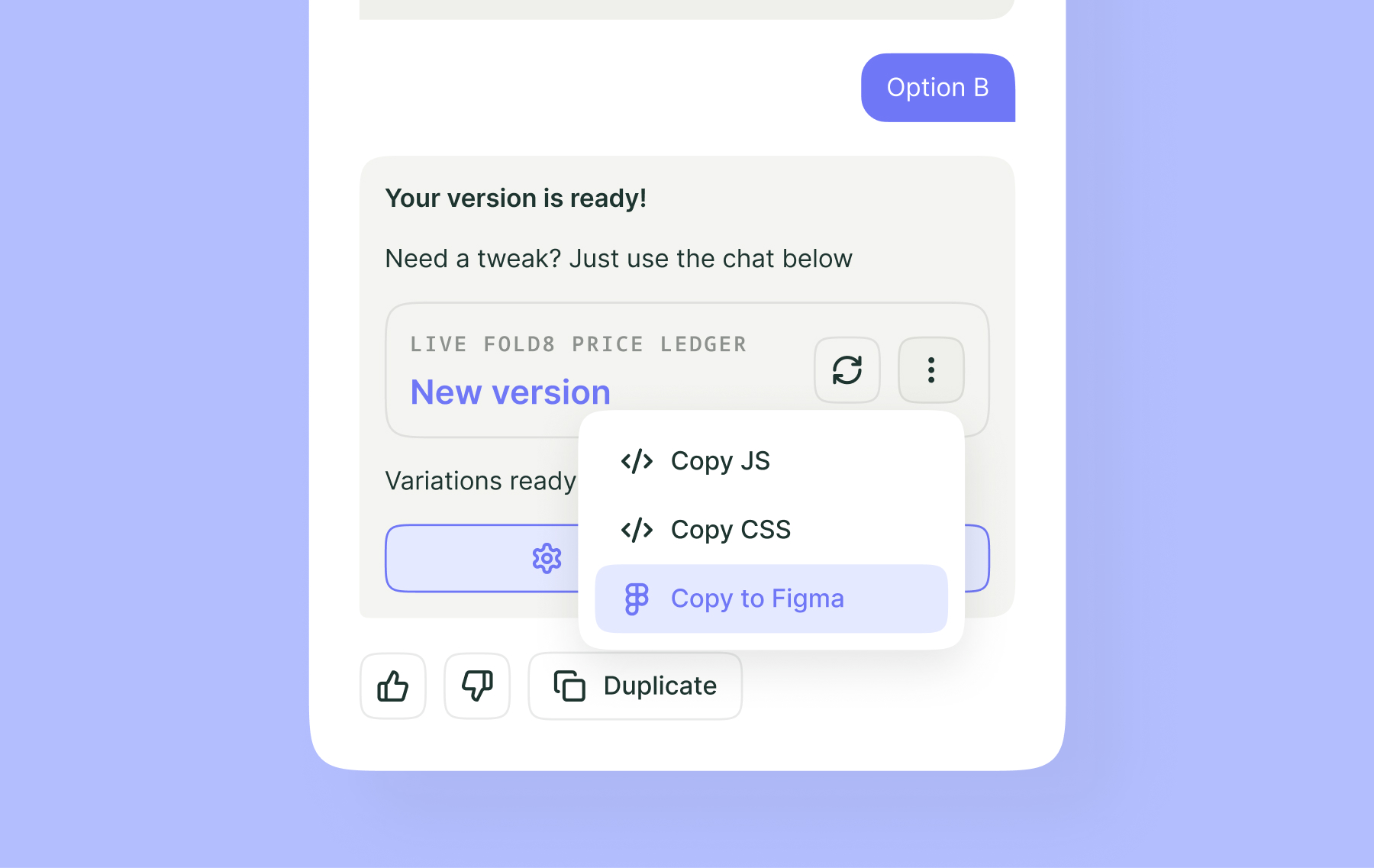
Then, it moves onto building. At every step, it asks for confirmation and guidance as it builds new variations by highlighting where it wants to make changes, suggesting design options when Figma files are not present, and reusing existing components wherever possible.
Once you confirm the variant is as you’d like, it moves to configure the experiment using the same natural-language interface as the builder tool, launching, and analyzing the eventual test in lockstep with the tester.
With LLMs the process becomes more of what you want from it. You can set up your process to consult with you as often as you’d like; it’s also possible to set up a fully autonomous system depending on your available time and confidence in the system.
Of course, giving AI total autonomy is rarely a good idea, especially when working with your codebase, which is why experimentation platforms are likelier to make sure all actions are approved by humans before any visitor or user has a chance to see them.
Which tool will you use to build your tests?
The expertise behind and within experimentation tools is what sets them apart from every other means of A/B testing. It makes much more sense in most cases to use experimentation tools for experimentation and general-purpose LLMs for fast prototyping and one-off changes. Then, use MCPs and APIs to link your code builder and experimentation tool across your organization. This way, every tool has a specific purpose and goal and you can get the most out of each one.
In general, use experimentation tools when:
- You want to run as many experiments as you can (within reason)
- You have marketing, product, data, and other non-technical teams that need to run tests without impacting developer backlogs
- Your development team isn’t able to make experimentation a priority
And use general-purpose LLMs when:
- Developers are the sole A/B testers
- You have extremely specific testing requirements and need the flexibility of LLMs
Using PBX as part of Speero’s How AI is changing who builds experiments and how report, a practitioner with a background in development noted:
{{quote}}
Context is always the difference.
FAQs
Yes. Claude is excellent at building variations and, paired with an engineer, at shipping winners into production. It is not, however, an experimentation engine. Traffic allocation, goal tracking, targeting, and statistical analysis still require a dedicated platform, and making experimentation accessible to non-technical teams requires prompt-based experimentation.
Yes, for the work that genuinely needs them. PBX takes engineering out of routine front-end tests, allowing engineers to focus on complex builds and shipping winning tests into the backend behind feature flags.
Not entirely; AI shifts developer work but it does not remove it. Prompt-Based Experimentation takes engineering out of routine front-end tests, but complex builds still require developers focus. Once you have a winner, you also need developers to ship winning tests into the backend behind a feature flag.
No. Claude can build variations, but running an experiment also requires putting it live on your site, allocating traffic, assigning and tracking goals, targeting audiences, and analyzing results with a valid statistical model. Those steps need an experimentation engine, and, unless you have a tool like PBX, they need an engineer too.
Prompt-Based Experimentation (PBX) is a new way to ideate, build, configure, analyze, and launch experiments. With PBX, you simply describe the web changes you want to test in natural language. AI then generates a variation and launches the experiment, without code or WYSIWYG editors.
Server-side tests are rendered on your infrastructure before any code is sent to your users’ browsers or before they download your app. You can design a server-side test either from scratch with the help of your own development team or by using an experimentation solution’s SDK. Client-side tests, on the other hand, insert a snippet of code sent to a user’s browser that controls how your site loads
.jpg)
"What PBX is trying to do is what we found missing in other tools is the context. We provide the prompt but without the AI having full access to the codebase, it's dependent on us to provide it the full context. That's where it seems very promising. It can go through, and I would assume that's where it's taking this time, it's just going through the DOM, trying to understand how the structure currently is, what is the booking widget, what selectors are matching with that. Which is truly impressive."

Part of the reason PBX can be so quick with page context is that it sits on your browser, so it already has access to the context it needs to accurately build variants (HTML, CSS, brand voice, the page’s appearance, and so on) and the built-in knowledge to do it. After all, it’s what they’re designed for.
Dedicated A/B testing tools can also configure experiments up to the launch, which means you can set up tracking metrics, target definitions, and goals during the same initial conversation. This leads to a faster and easier experience compared with general-purpose LLM tools, and little additional time dedicated to configuration.
Try PBX for free today to see how well experimentation tools can support end-to-end A/B testing for all teams in your organization.
Try PBX for free today to see how well experimentation tools can support end-to-end A/B testing for all teams in your organization.